
In our opinion, except for the possible effects of the matter described in the Basis for qualified opinion section of our report, the consolidated financial statements present fairly, in all material respects, the consolidated financial position of Blue Label Telecoms Limited and its subsidiaries (together the Group) as at 31 May 2022, and its consolidated financial performance and its consolidated cash flows for the year then ended in accordance with International Financial Reporting Standards and the requirements of the Companies Act of South Africa.
Blue Label Telecoms Limited's consolidated financial statements set out on pages 18 to 112 comprise:
Our audit report dated 26 August 2021 on the consolidated financial statements of the prior year contained a qualified audit opinion. That qualification arose due to our inability to obtain sufficient and appropriate audit evidence to support the going concern assumption at the Group's equity-accounted associate, Cell C Limited (“Cell C”). As disclosed in note 2 to the consolidated financial statements, the restructuring of the operations and capital structure of Cell C is still in progress and the outcome thereof remains uncertain as at the date of this audit report. As a result, we are still unable to obtain sufficient and appropriate audit evidence to support the going concern assumption for Cell C.
Under an alternative basis of preparation, the assets and liabilities of Cell C may be impaired, measured at fair value rather than cost, or written off entirely, depending on how Cell C plans to recover or settle these assets and liabilities.
The possible effect of this matter on the consolidated financial statements would be that the disclosure of the summary financial information of Cell C for both the current and prior year, as presented in note 2.1 to the consolidated financial statements may require material adjustment. Such material adjustment would have no impact on the current year or prior year group income statement or group statement of financial position as the investment in Cell C was fully impaired as at 31 May 2019, at which date the group ceased equity accounting for the losses of Cell C.
We conducted our audit in accordance with International Standards on Auditing (ISAs). Our responsibilities under those standards are further described in the Auditor's responsibilities for the audit of the consolidated financial statements section of our report.
We believe that the audit evidence we have obtained is sufficient and appropriate to provide a basis for our qualified opinion.
We are independent of the Group in accordance with the Independent Regulatory Board for Auditors' Code of Professional Conduct for Registered Auditors (IRBA Code) and other independence requirements applicable to performing audits of financial statements in South Africa. We have fulfilled our other ethical responsibilities in accordance with the IRBA Code and in accordance with other ethical requirements applicable to performing audits in South Africa. The IRBA Code is consistent with the corresponding sections of the International Ethics Standards Board for Accountants' International Code of Ethics for Professional Accountants (including International Independence Standards).
Overview |
|
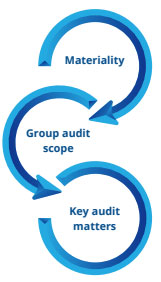 |
Overall group materiality
Group audit scope
Key audit matter
|
As part of designing our audit, we determined materiality and assessed the risks of material misstatement in the consolidated financial statements. In particular, we considered where the directors made subjective judgements; for example, in respect of significant accounting estimates that involved making assumptions and considering future events that are inherently uncertain. As in all of our audits, we also addressed the risk of management override of internal controls, including among other matters, consideration of whether there was evidence of bias that represented a risk of material misstatement due to fraud.
The scope of our audit was influenced by our application of materiality. An audit is designed to obtain reasonable assurance whether the financial statements are free from material misstatement. Misstatements may arise due to fraud or error. They are considered material if individually or in aggregate, they could reasonably be expected to influence the economic decisions of users taken on the basis of the consolidated financial statements.
Based on our professional judgement, we determined certain quantitative thresholds for materiality, including the overall group materiality for the consolidated financial statements as a whole as set out in the table below. These, together with qualitative considerations, helped us to determine the scope of our audit and the nature, timing and extent of our audit procedures and to evaluate the effect of misstatements, both individually and in aggregate on the financial statements as a whole.
Overall group materiality |
R 124.6 million |
How we determined it |
0.7% of consolidated revenue from continuing operations. |
Rationale for the materiality benchmark applied |
Consolidated revenue from continuing operations was selected as the benchmark because, in our view it is the benchmark against which the performance of the Group can be consistently measured, as it is an indicator of market share, which is considered to be the key objective and focus of the Group's business model and users. Profit before tax is not considered an appropriate benchmark due to its historical volatility. We chose 0.7% based on our professional judgement and after consideration of the range of quantitative materiality thresholds that we would typically apply when using revenue to compute materiality. The considerations included taking cognisance of the intended users and distribution of the financial statements, the financial covenants held over the Group's debt as well as the inherent risk of the entity. |
We tailored the scope of our audit in order to perform sufficient work to enable us to provide an opinion on the consolidated financial statements as a whole, taking into account the structure of the Group, the accounting processes and controls, and the industry in which the Group operates.
The Group is made up of four segments, Africa Distribution, International, Solutions and Corporate. The Group's main operating subsidiaries and associates are located in South Africa. In establishing the overall audit approach to the Group audit, we determined the type of work that needed to be performed at the local operations by ourselves, as the Group engagement team, or component auditors from other PwC network firms and firms external to PwC operating under our instructions. The Group's operations vary in size. Within these segments, we have identified 11 components on which we performed either full scope audits, audit of specific financial statement line items or review for group reporting purposes depending on their financial significance and contribution to the risk of material misstatement in the consolidated financial statements. Analytical procedures were performed over all components not in scope, to confirm our risk assessment and that no additional audit procedures were required.
Detailed Group audit instructions were communicated to all components in scope and comprehensive audit approach and strategy planning meetings were held with all in scope component teams before commencing their respective audits. Throughout the audit, various calls and discussions were held with the teams of these components.
We assessed the competence, knowledge and experience of the component auditors and evaluated the procedures performed on the significant audit areas to assess the adequacy thereof in pursuit of our audit opinion on the consolidated financial statements.
Where the work was performed by the component auditors, we determined the level of involvement we needed to have in the audit work at these operations to be able to conclude whether sufficient appropriate audit evidence has been obtained as a basis for our opinion on the consolidated financial statements as a whole.
Key audit matters are those matters that, in our professional judgement, were of most significance in our audit of the consolidated financial statements of the current period. These matters were addressed in the context of our audit of the consolidated financial statements as a whole, and in forming our opinion thereon, and we do not provide a separate opinion on these matters. In addition to the matter described in the Basis for qualified opinion section, we have determined the matters described below to be the key audit matters to be communicated in our report.
Key audit matter |
How our audit addressed the key audit matter |
Impairment assessment of goodwill arising from business combinations |
|
|
The Group has entered into various business combinations in prior years, which resulted in significant goodwill being recognised. The goodwill recognised in these business combinations relates mainly to expected synergies that the Group expects to derive from the transactions. As required by IFRS, goodwill is tested annually for impairment or whenever there is an impairment indicator identified by management. The process of assessing impairment is complex and highly judgmental, and is based on a number of critical assumptions, estimates and judgements, including the terminal growth rate, discount rate and forecasted cash flows, which are affected by expected future market or economic conditions. Changes in these assumptions may lead to an impairment charge being recognised for the remaining goodwill balances. Management's annual goodwill impairment assessments were identified as a matter of most significance to our audit because of the quantum of goodwill as at 31 May 2022, the significant judgement and estimates involved in determining the year-on-year EBITDA growth rates, subscription bases (where appropriate), terminal growth rate, discount rate and forecast cash flows, including the future market or economic conditions faced by the various businesses within the Group. |
For material goodwill balances, for which the recoverable amount was determined, our audit procedures included the following:
|
|
Management performed an impairment assessment over the goodwill balance as at 31 May 2022 by performing the following:
Refer to note 4.1 to the consolidated financial statements for details of management's impairment tests and assumptions. |
|
The directors are responsible for the other information. The other information comprises the information included in the document titled “Blue Label Telecoms Limited Annual Financial Statements 2022” and “Blue Label Group Annual Financial Statements 2022”, which includes the Directors' Report, the Audit, Risk and Compliance Committee's Report and the Declaration by the Company Secretary as required by the Companies Act of South Africa, which we obtained prior to the date of this auditor's report, and the other sections of the document titled “Blue Label Telecoms Integrated Annual Report 2022”, which is expected to be made available to us after that date. The other information does not include the consolidated or the separate financial statements and our auditor's reports thereon.
Our opinion on the consolidated financial statements does not cover the other information and we do not and will not express an audit opinion or any form of assurance conclusion thereon.
In connection with our audit of the consolidated financial statements, our responsibility is to read the other information identified above and, in doing so, consider whether the other information is materially inconsistent with the consolidated financial statements or our knowledge obtained in the audit, or otherwise appears to be materially misstated.
If, based on the work we have performed on the other information that we obtained prior to the date of this auditor's report, we conclude that there is a material misstatement of this other information, we are required to report that fact. As described in the Basis for qualified opinion section above, we were unable to obtain sufficient appropriate audit evidence supporting the application of the going concern assumption at Cell C, and its impact on the disclosure of summary financial information for Cell C in the consolidated financial statements of the Group. Accordingly, we are unable to conclude whether or not the other information is materially misstated with respect to this matter.
The directors are responsible for the preparation and fair presentation of the consolidated financial statements in accordance with International Financial Reporting Standards and the requirements of the Companies Act of South Africa, and for such internal control as the directors determine is necessary to enable the preparation of consolidated financial statements that are free from material misstatement, whether due to fraud or error.
In preparing the consolidated financial statements, the directors are responsible for assessing the Group's ability to continue as a going concern, disclosing, as applicable, matters related to going concern and using the going concern basis of accounting unless the directors either intend to liquidate the Group or to cease operations, or have no realistic alternative but to do so.
Our objectives are to obtain reasonable assurance about whether the consolidated financial statements as a whole are free from material misstatement, whether due to fraud or error, and to issue an auditor's report that includes our opinion. Reasonable assurance is a high level of assurance, but is not a guarantee that an audit conducted in accordance with ISAs will always detect a material misstatement when it exists. Misstatements can arise from fraud or error and are considered material if, individually or in the aggregate, they could reasonably be expected to influence the economic decisions of users taken on the basis of these consolidated financial statements.
As part of an audit in accordance with ISAs, we exercise professional judgement and maintain professional scepticism throughout the audit. We also:
We communicate with the directors regarding, among other matters, the planned scope and timing of the audit and significant audit findings, including any significant deficiencies in internal control that we identify during our audit.
We also provide the directors with a statement that we have complied with relevant ethical requirements regarding independence, and to communicate with them all relationships and other matters that may reasonably be thought to bear on our independence, and where applicable, actions taken to eliminate threats or safeguards applied.
From the matters communicated with the directors, we determine those matters that were of most significance in the audit of the consolidated financial statements of the current period and are therefore the key audit matters. We describe these matters in our auditor's report unless law or regulation precludes public disclosure about the matter or when, in extremely rare circumstances, we determine that a matter should not be communicated in our report because the adverse consequences of doing so would reasonably be expected to outweigh the public interest benefits of such communication.
In terms of the IRBA Rule published in Government Gazette Number 39475 dated 4 December 2015, we report that PricewaterhouseCoopers Inc. has been the auditor of Blue Label Telecoms Limited for 18 years.
Director: Pietro Calicchio
Registered Auditor
Johannesburg, South Africa
25 August 2022

