
I am pleased to report that the Human Capital team at Blue Label and Blue Label Remuneration Committee continued to prioritise staff welfare as we navigated another year of
COVID-related challenges.
Our Remuneration Policy, amended significantly in 2020 to align with best practice, together with the Implementation Report and Non-executive Directors fees, were put to a shareholder vote at the previous AGM on 25 November 2021 and were endorsed with a majority vote of 98.8% and 81.2% respectively. Each year we engage with our shareholders to ensure alignment of our policy and their goals.
It is also vital that our Remuneration Policy aligns with best practice and achieves our goals of attracting and retaining top talent. During the reporting period, PwC was engaged to review our overall remuneration policy and the underlying variable remuneration structures to assess their alignment with leading market practice and good corporate governance principles. The updates to our remuneration practices to align with market/best practice continue as at the time of this publication, to be reported on fully, as necessary, in our 2023 report.
As in the previous year, and in line with best practice, no metrics or targets, have been or will be retrospectively adjusted but the policy ensures that the Remuneration Committee has the flexibility in setting appropriate metrics and targets on an annual basis. For the reporting year, the Committee has however evaluated the impact on EBITDA as a consequence of the Group initiating a learnership programme which negatively impacts EBITDA but which after deducting the S12H allowance in terms of the Income Tax Act, should leave our bottom line NPAT unchanged. Consequently, the Committee agreed that it would be appropriate to evaluate EBITDA on a normalised basis adjusting only for the extra spend on the learnership programme.
Section 1 provides an overview of how the Remuneration Committee has championed our alignment to King IV's Code on Corporate Governance, our areas of focus in achievement of our policy objectives, our efforts to build a culture through values and our purpose and alignment with performance and rewards. We also address diversity and inclusion, gender and race remuneration parity and setting new ESG goals.
Section 2 summarises our forward-looking remuneration philosophy and policy, together with an overview of our total rewards strategy. The most significant change for the year ahead relates to our long-term incentive plan, and updates which have been made to its administration, as discussed in detail below. Given PwC's ongoing review and the updates required as a result thereof, we anticipate that next year's report will disclose these changes in detail. Minor changes were made to move threshold to 80% of target and stretch to 125% of target for financial measures in both the short-term incentive plan (STIP) and long-term incentive plan (LTIP). We removed the stretch component of the individual key performance indicator (KPI) targets in the STI and the ESG measures in the LTIP, as these measures are assessed on a binary basis and only provide for the achievement of target performance, with threshold performance being assessed on a pro-rata basis relative to target. Financial metrics were slightly amended to match realistic and benchmarked targets noting prevailing economic conditions in the country. The full policy can be accessed here https://www.bluelabeltelecoms.co.za/sus-governance-framework.php. We also highlight our continued focus areas for FY2023.
Finally, section 3, the Remuneration Implementation Report, provides an overview of FY2022 performance and discloses performance against targets and resulting awards to Executive Directors, Prescribed Officers as well as the fees paid to Non-executive Directors.
Looking forward to FY2023, we will continue to review the success of our Remuneration Policy in terms of both our and stakeholders' goals. We have to be mindful of the challenges facing our country and what role we need to play in addressing these. Together with ESG, these will be our prioritised goals for the forthcoming year.
We invite engagement with our shareholders as part of our efforts to continuously review and improve.
GD Harlow
Chairman
30 September 2022
It remains the responsibility of the Remuneration Committee Chairman to give feedback to the Board after every Remuneration Committee meeting of any key decisions and relevant discussions. The Remuneration Committee is committed to applying the King IV principles regarding responsible and transparent remuneration practices, assisted by regular benchmarking exercises. As noted hereinabove, during the reporting period, PwC was engaged to review the Company's remuneration policy and practices, specifically its variable remuneration structures against leading market practice and corporate governance as well as the Company ongoing business strategy. The Remuneration Committee confirmed their independence in this mandate as well as their objectivity.
This is discussed in more detail below.
The management team's focus in the past year was a "back to basics" plan. We believe the short and long-term incentive components of our remuneration policy, strongly assisted in the achievement of our goals. Rewards were well earned after an exceptional operational performance.
The Remuneration Committee was not required to consider any request to deviate from policy other than a "normalisation" of actual EBITDA, taking into account the additional expenses incurred on the new learnership programme which we implemented. In this regard, the adjustment required to normalise EBITDA in the current and prior year amounted to R65 million and R10 million respectively.
The Remuneration Committee believes that the Blue Label remuneration philosophy and policy remain fit for purpose and achieves the high-level objectives of attraction, retention, and performance motivation of our employees. We took the same approach as last year by taking into consideration the challenges in the country and allowing the Remuneration Committee to have flexibility in the determination of performance metrics and other elements that would typically be addressed yearly, rather than codified into a policy without change.
This has the added benefit of ensuring that metrics and targets associated with remuneration remain relevant through changing business environments.
The Remuneration Committee prioritised and achieved the following objectives during the FY2022 year:
An inclusive leadership culture shifts the impact on the employer-employee relationship. We believe the right culture is a huge factor in driving long-term employee engagement, organisational performance, brand loyalty and customer satisfaction. The talent pool we are targeting are attracted to organisations with robust environmental and social commitments. We have worked on a range of initiatives in our social responsibility projects together with our employees.
We have successfully completed career discussions and people planning, with succession plans in place for all management. Research has shown that employees feel their work is more meaningful when organisations show that they are:
Employees desire to work for organisations that reflect their values and have a positive impact on the world around them.
BluTrain, a subsidiary in the group, has been appointed to support and encourage a culture of learning within the organisation. The programme accommodates approximately 3 600 unemployed learners and 539 employed learners across the Blue Label Group. This is consistent with the Group's goals to focus on Skills Development and Enterprise Development. Although the new learnership initiatives impacts negatively on EBITDA, the benefit thereof is realised by way of income tax savings as a result of the section 12H allowances being claimed for such learnerships.
Paying for performance remained at the core of the Group's and the Remuneration Committees' philosophy.
For employees, management and executives, an increase in fixed pay of up to 6% was approved, based on an individual performance rating. These decisions were aligned to the reported inflation rate.
Key recommendations were to table a revised Share Incentive Scheme for shareholder approval. The primary motivation was driven by the limits imposed on the old scheme which was based on significantly lower shares in issue. The second motivation was to convert the scheme from a Forfeitable Share Award to a Conditional Share Award to allow the Company to better plan the purchase of shares to be awarded, optimising flexibility and the cost thereof.
The benchmarking exercise by PwC led to recommendations of some policy changes or small amendments for the forthcoming year, to align to best prevailing practice. These were linked to the changes for the targets for the financial metrics in both the STI and LTIP plans, threshold and stretch target percentages and removing stretch performance level for individual KPI and ESG targets, as these targets are binary. After extensive deliberation and taking into consideration leading local and global market practices as well as Blue Label's strategic objectives, the Committee will table a number of the proposed changes for shareholder approval.
The Committee considered amendments to the current performance metrics for the forthcoming year and after recommendations from PwC and considering market benchmarks, made the following adjustments for the forthcoming year in line with economic conditions and best practice:
We also tabled these to some of our larger shareholders, for feedback and comment prior to convening the AGM voting resolutions.
During PwC's review of our remuneration structures, the RemCo decided that in line with evolving market practice and shareholder alignment, the long-term incentive plan should be updated to operate as a Conditional Share Plan. Accordingly, the Forfeitable Share Plan rules approved in 2008 by shareholders have been updated to cater for the following:
One of the other main changes relates to the applicable share schemes limits. The 2008 set of rules were approved with an overall limit of 10% of the total issued shares of the Company as at 2008, equating to c.76.64 million shares. As it is the Company's intention to continue using the plan albeit as an amended conditional share plan, as per the 2022 Notice of AGM, shareholders are requested to approve an adjustment of the overall plan limit to c.91.37 million shares, which would retain a limit of 10% of the total issued shares of the Company as at the date of AGM, but provide c.14.73 million further shares for settlement of awards, thereby prolonging the life of the structure for an additional period. The updating of this limit maintains the principle of utilising 10% of the issued share capital and shareholders are no further diluted by the updated limit, than they were as at the original approval of the structure. In addition, measurement of the depletion of the limit will be based on shares vested and settled to participants and not shares allocated to participants as was the case historically.
Confirmation is furthermore provided that once the share scheme limit above has been fully depleted through the use of a treasury function which hedges Blue Label's exposure to share price fluctuations, Blue Label will thereafter settle all subsequent awards solely through the use of a market purchase of shares, which is non-dilutive to shareholders.
Similarly, shareholders are asked to approve an adjustment of the conditional share plan's (previously forfeitable share plan's) individual limit from c.7.66 million shares to c.9.13 million shares, which, while updating the number of shares available for individual participants, would retain the limit of 1% of total issued shares, as approved by shareholders as at adoption of the structure. As noted above regarding the adjustment of the overall limit, this adjustment would not lead to further shareholder dilution.
Given that the bulk of amendments are made to simplify the administration of the structure and to bring its provisions in line with best practice in corporate governance, we anticipate and trust that shareholders would support them.
As noted hereinabove, as at the time of this publication, the Company continues to engage PwC in the review of its remuneration policy and overall variable remuneration practices.
As part of this process and given that the Group has made a number of acquisitions within the last decade, a review shall be undertaken during FY23, in addition to the changes proposed to the long-term incentive policy outlined above. This review will look at the underlying rules and the Company's pay bands; whether these are sufficiently stratified and whether the participating employees within the bands are receiving a market-related mix of fixed and variable remuneration.
To the extent that it is determined that this is not the case, the Committee will review and adjust the bands and variable remuneration allocation methodologies and quanta, as may be required for market-alignment. Additionally, a formal analysis of the participants of the long-term incentive plan will be conducted, determining which participants should remain on an equity-settled long-term incentive plan and which should be placed on a similar cash-settled structure. Of course, and aligned to King IV, this would exclude executive directors and prescribed officers, who would remain on an equity-settled long-term incentive plan to ensure overall alignment with shareholders.
Further, to the extent that the Remuneration Committee becomes aware that there is significant misalignment between current pay band grading and the total reward review outcomes, discretion will be applied in how the remuneration policy is applied during FY23. Such discretion is intended primarily for levels below executive director and prescribed officers and shall be applied with caution and after careful consideration to executive directors and prescribed officers. Aligned with our policy in circumstances where discretion is applied, such discretion will be applied reasonably within the ambit of the principle of pay for performance and taking into account Blue Label's commitment to fair and responsible remuneration. Where any additional remuneration structures are introduced, these will be self-funding and be evaluated against the appropriateness of total remuneration relative to market.
Our rewards policy, value proposition, culture and ESG objectives must align with our purpose. Through good ethics and good commercials, it is our social responsibility to generate value for all. In this way we will:
We have partnered with Deloitte to perform a gap analysis of our ESG goals and metrics and will compile a three-year plan with new measurable objectives.
In line with the JSE Listings Requirements and King IV, we will table the following resolutions for shareholders voting at the AGM:
Shareholders are invited to engage on our remuneration policy and this remuneration report by sending a request for engagement to the Chairman of the Remuneration Committee at investors@blts.co.za.
The Committee is mandated by the Board to continually assess the executive remuneration market and governance framework.
The Committee will consider current market conditions, Blue Label's strategy and operational performance. We anticipate focusing on the following in FY2023:
Blue Label recognises that our people are one of our biggest assets and believes that it is important to allow each individual to thrive as an individual and grow their career, while excelling and succeeding together as an organisation. Our remuneration policy and practices, together with our WeLead programme, aims to create awareness of how important it is to be resilient, be achievement-driven and have a winning mindset.
We aim with our Employment Value Proposition (EVP) of #HappinessisBlu and employee engagement #teamblu programmes, to differentiate ourselves from our peers. Our all-in culture creates a safe environment that leads to increased productivity and innovation.
This together with our remuneration policy, enables us to:
This applies to all subsidiaries, associates and joint venture companies in which the Group holds a shareholding in excess of 40%, excluding Cell C who have their own remuneration policy and committee. The Remuneration Committee may approve by exception for the policy to apply to seconded Blue Label employees.
Our objective is to be an employer of choice and our employee brand and reward programme should be designed to help us achieve this.
Our localised benchmark on guaranteed pay practices helps us to stay committed to remuneration packages that are competitive and relevant for the role and experience.
We strive to pay for performance and therefore structure remuneration around this. This allows us to reward strong individual performance as well as strong organisational performance. We apply malus and clawback provisions to vested and unvested LTIP awards for management.
As far as possible, remuneration differentiation between employees is based on fair and objective criteria. The Committee has a policy in place which is aimed at monitoring and continuously addressing any fair pay related matters. We have completed a pay equity analysis this past year as part of our commitment to diversity, equity, and inclusion. It helps us stay competitive as an employer, meet shareholder expectations, and ensure legal compliance. Our process included gathered data to analyse internal job grading in relation to remuneration and benchmarks (salary information, position information, tenure, and seniority). The analysis helps us identify pay differences within the company. Further research was conducted to interpret and understand what causes the difference in pay. The final step is to take the results from the analysis report and communicate with each subsidiary leadership team to derive an implementation plan on how to close the gaps in the next two years to correct discrepancies.
During the reporting year, the representation of women and African employees in leadership was a key focus of the Committee and the Board. In this regard, the following is noted:
70% of all promotions were awarded to equity candidates, 39% to women and 47% to African. Of all new appointments, 46% were women and 54% men. We will continue to focus on recruiting and promoting the right talent and driving our equity plan.
At Blue Label, we adopt a holistic approach to rewards, which includes guaranteed pay, variable pay, recognition and employee development and benefits.
We understand that the philosophy and each component of the policy are dynamic and should be reviewed from time to time to ensure we keep abreast of our objectives and market trends. We ensure that our practices comply with legislative and regulatory requirements.
We provide transparent and understandable information about our reward programme, policy and processes, to all employees to ensure that employees understand what they receive, why and when they receive it.
Blue Label's reward framework comprises financial and non-financial components and applies to all employees. The framework is set out below:
At Blue Label the pay mix differs when specific business circumstances require it, including costs and allowances related to relocation and international assignments. We reimburse all necessary and reasonable business expenses.
| Guaranteed | Variable | Non-financial | ||||
| Fixed annual remuneration | Sales commissions | Short-term incentive plan | Short-term variable remuneration | Long-term incentive plan | #HappinessisBlu | |
| Objectives |
Enables us to attract and retain talent, taking into consideration skills, experience, high potential and value contribution. |
Aligned to drive continuous improvement, improved customer service and increased revenue in sales and operations. |
Reward the achievement of challenging strategic, financial and operational objectives, aligning individuals to divisional and Group performance and the interests of our shareholders. The scheme is structured to reward collaborative work across the Group to ensure we leverage our capabilities, increase innovation, improve customer and consumer service, reduce inefficiencies and increase revenue and profits. |
Special-purpose variable remuneration arrangements to help attract and retain high potential talent who are the holders of scarce skills. Arrangements are subject to individual performance and time-based conditions to ensure an appropriate return on the remuneration investment. |
Aligning employees to shareholder interests through incentivising performance in line with strategic goals and long-term shareholder value. |
Create a differentiated EVP and work experience to increase the engagement and retention of existing employees and position Blue Label as an employer of choice within an increasingly competitive landscape. |
| Eligibility |
All. |
Specific roles within sales and operations. |
All. |
|
Executives and management. |
All. |
| FY2023 approach |
As in FY22, the Remuneration Committee recommended up to 6% increases for FY2023. Increases awarded on exception to retain critical skills and high performing talent. |
As defined by the operational plan and budget. |
Schemes with varying components linked to:
Gatekeeper conditions are in place. Individual metrics are limited to five KPIs and must be verifiable and challenging. The following financial measures will be applied in determining the STIP for Group head office and Executive Directors:
The following financial measure will be applied in determining the STIP at divisional levels:
Further details on targets can be found in the remuneration policy. |
Cash-based sign-on awards and retention bonuses are assessed on a case-by-case instance in line with policy. |
Conditional shares are offered (instead of forfeitable shares as has been done historically). The following metrics apply:
|
Individualised employee engagement, development and growth. |
FAR is a critical enabler in the attraction and retention of human capital, taking into regard skills, experience, high potential and value contribution. The components of guaranteed fixed remuneration are:
To ensure we apply the right competitive remuneration, we collected industry and country-relevant benchmarks from Deloitte and KornFerry. Fair and competitive compensation is critical to being an employer of choice.
Blue Label's annual salary review process provides an opportunity for management to reward for performance and adjust salaries in line with market increases and organisational affordability. Blue Label's annual performance-based increases are effected in June each year. We aim to differentiate between non-performance, average performance and exceptional performance. The Committee mandated up to 6% increases for FY2023. The Remuneration Committee further mandated that where appropriate, by exception, higher increases may be awarded to retain critical skills and high–performing talent, or where there were enhanced responsibilities.
Our STIP reward the achievement of critical short-term metrics comprising both financial and non-financial measures. Our STIP also reward self-development and focus on developing others and the economic development of the communities we serve. In line with our entrepreneurial spirit, targets and metrics are challenging and align individuals KPIs to divisional and Group performance and the interests of our shareholders.
We have introduced further incentives for managers to use within exceptional instances. The special-purpose short-term variable remuneration arrangements have been designed to help attract and retain high potential human capital who are the holders of scarce skills.
The emphasis remains on performance beyond target for Executive Directors for FY2023:
The Executive Directors thresholds and stretches are currently calculated as follows:
| Metrics | Threshold | Target | Stretch* | |
| KPIs (20%) | Individual** Pro-rata of target |
Pro-rata of target 16% – CEOs 10% – FD |
Specific 20% – CEOs 14% – FD |
No stretch 20% – CEOs 14% – FD |
| Normalised EBITDA (40%) (adjusting for the additional expenses linked to the learnership programme) | Group Payout % of FAR |
80% of target 32% – CEOs 20% – FD |
CPI + 10% 40% – CEOs 28% – FD |
125% of target 65% – CEOs 43% – FD |
| Core HEPS (40%) | Group Payout % of FAR |
80% of target 32% – CEOs 20% – FD |
CPI + 10% 40% – CEOs 28% – FD |
125% of target 65% – CEOs 43% – FD |
| # | The bonus is calculated per metric. Values awarded will be a weighted average of scores attained versus target and pro-rated applying linear interpolation. |
| * | Remco discretion to be applied for performance above target. |
| ** | RemCo removed the stretch component of the individual KPI targets in the STIP as these measures are assessed on a binary basis and only provide for the achievement of target performance, with threshold performance being assessed on a pro-rata basis relative to target. |
Remco will be guided by economic conditions and an annual review of the performance target percentage above CPI, with the most relevant metrics selected each year.
Executive Directors' composition of FY2023 total remuneration
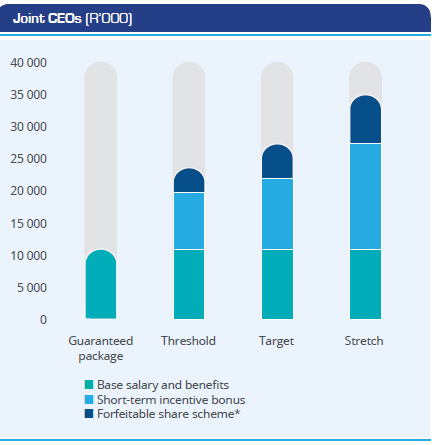
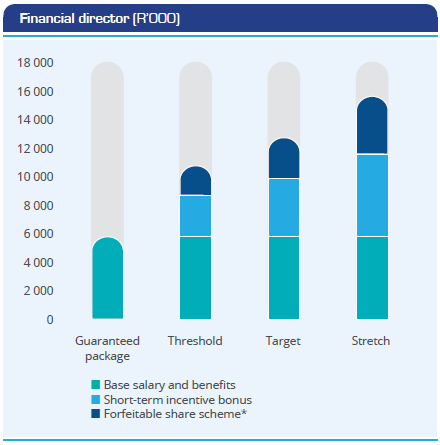
* Forfeitable share scheme vesting in August 2025.
Blue Label's LTIP aligns employees to shareholder interests through incentivising performance in line with strategic goals and long-term shareholder value creation. In addition, it aims to retain human capital with scarce or critical skills. The Remco, through engagement with shareholders, and guided by consultants through market benchmark reviews, has determined applicable criteria for the LTIP, ensuring that the interests of all stakeholders are appropriately considered.
These may be reviewed and adjusted in future, upon further engagement with shareholders. Awards are made once a year post our annual performance and pay reviews. All awards are subject to the necessary governance and approval processes. Awards are subject to vesting over a period of three years from the date of the grant.
Minimum levels of financial performance must be achieved. Employees who do not meet minimum performance requirements or are on a performance improvement plan, are not eligible. To the extent ordinary resolution 9 is approved, the following LTIP will be operated.
| Aspect | Description |
| Nature |
Blue Label's long-term incentive plan is operated as a conditional share plan. |
| Eligibility |
Eligibility based on:
|
| Allocation methodology |
Allocation awards for Executive Directors are currently as follows:
|
| Performance conditions |
Refer to the table below for FY23 performance metrics, weightings and associated targets. |
| Performance period |
Three years |
| Vesting period and profile |
Three years, from the date of the award. Cliff vesting applies. |
| Plan limits |
Overall plan limit: 10% of issued shares (c.91.37 million shares) Individual participant limit: 1% of issued shares (c.9.14 million shares) |
| Termination of employment |
Bad leavers: In cases of resignation or dismissal prior to vesting, all unvested awards are forfeited. Good leavers: In cases of retrenchment, death, ill health, disability of any other reason, a portion of unvested awards, or such greater portion as the Board may determine in its absolute discretion, shall vest and be settled upon the date of termination of employment, pro-rated for time served between the award date and the date of termination, as well as for the extent to which performance has been achieved over the relevant period. Retirement: Participants shall be entitled to the same rights and be subject to the same conditions as if they had continued to be an employee, unless the Board/Remuneration Committee decides otherwise. |
The following metrics apply for each award:
| Metrics | Threshold | Target | Stretch | |
| Core HEPS (30%) (compounded cumulatively over three years) |
Group | 80% of target | CPI + 7.5%** | 125% of target |
| Vesting % | 21.6% | 30% | 45% | |
| TSR (30%) (performance against long bond compounded over three years plus spread) |
Group | 80% of target | Performance equal to three to five year SARB nominal long bond rate +7.5%*** | 125% of target |
| Vesting % | 21.6% | 30% | 45% | |
| ROCE**** (20%) (compared to WACC over the three-year period not compounded) |
Group | ROCE greater than or equal to WACC over three years | ROCE greater than or equal to WACC +2.5% over three years | ROCE greater than or equal to WACC +5% over three years |
| Vesting % | 14.4% | 20% | 30% | 30% |
| ESG (20%) (specific ESG metrics*****) |
Group | Pro-rata of target | Specific | No stretch |
| Vesting % | 14.4% | 20% | 20% | |
| * | Remco may review metrics and targets post-FY2023 for new awards to ensure that they are relevant. The LTIP is calculated per metric. Values awarded will be a weighted average of scores attained versus target. All metrics will be assessed and vest on a pro-rata basis applying linear interpolation basis, save for the ESG metric which will be assessed on a binary basis. |
| ** | The rationale for using a spread above CPI of 7.5%, which is lower than the spread being applied for the STIP, is that the LTIP is assessed on a forward-looking three-year basis while the STIP only looks to performance in the next 12 months. |
| *** | In setting the TSR target, consideration was given to utilise a risk-free rate that is aligned with a typical vesting and performance period of the award, consequently a 3-5 SARB nominal long bond rate was applied as the anchor in setting TSR targets, with an appropriate spread applied to this anchor in order to set realistic but stretching targets. In addition, TSR will be assessed based on growth in market cap as well as dividends distributed to shareholders over the performance period. |
| **** | ROCE is calculated using the following formula: ROCE = Net operating profit (EBIT)/Capital employed. Capital employed = total assets –current liabilities (excluding interest-bearing borrowings). The Remuneration Committee will review any prior year impairments to assess if adverse outcomes have occurred, and if so, make the necessary adjustments to the capital employed number such that the average performance is a more accurate indication to shareholders over the measurement period. |
| ***** | RemCo removed the stretch component of the ESG KPIs in the LTIP as these measures are assessed on a binary basis and only provide for the achievement of target performance, with threshold performance being assessed on a pro-rata basis relative to target. |
As noted in Part 1, as at the time of this publication, the Company continues to engage PwC in the review of its remuneration policy and overall variable remuneration practices. During the upcoming year in addition to the employee wide pay band stratification process, a formal analysis of the participants of the long-term incentive plan will be conducted, determining which participants should remain on the equity-settled long-term incentive plan (Conditional Share Plan) and which should be placed on a similar cash-settled structure. Further information regarding this process shall be detailed in next year's remuneration report.
This ensures that excessive risk-taking is not rewarded. This malus and clawback clause applies to both vested and unvested 'at risk' remuneration. It is designed to be preventative rather than a purely remedial or punitive measure as it removes the incentive for executives to consider deliberately misstating company earnings to inflate variable pay. The clause applies to both the STIP and LTIP from June 2019 and September 2019 respectively. The provision may be implemented up to 10 years after a trigger event and is applicable to financial year ended 31 May 2020 and each financial year-end thereafter.
The Board may act on the recommendation of the Remuneration Committee to adjust (malus) or recover (clawback) unvested and vested 'at risk' remuneration where there is reasonable evidence that a Blue Label employee has materially contributed to, or been materially responsible for, the need for the restatement of financial results.
The malus and clawback clause does not apply in the case of a restatement of financial results caused by a change in applicable accounting standards or interpretations thereof, provided originally approved by the Company's auditor.
The CEOs or Company Secretary are required to notify the Chairman of the Remco and the Chairman of the Board respectively, of any circumstances that could constitute a 'trigger' under this policy as soon as practical. If either the CEOs or Company Secretary is involved in the trigger event, the Head of Group Risk and Compliance is required to notify the Chairman of the Remco and the Chairman of the Board respectively.
Before the Remco makes a recommendation to the Board to implement malus or clawback provisions under the policy, they shall:
Having completed an investigation and following due process, the Board, on advice from the Remco, may decide to clawback, cancel or adjust any vested or unvested STIP or LTIP awards, where they are not satisfied that an award is appropriate or warranted due to exceptional circumstances.
To further align the Executive Directors' interests directly with those of shareholders and to encourage long-term commitment to the organisation, Executive Directors will be required to accumulate a prescribed minimum holding of share allocations within five years from September 2019. Joint CEOs will be required to accumulate two times their Fixed Annual Remuneration over a period of five years.
Our joint CEOs own a significant shareholding in Blue Label, and we will continue to review this.
The FD will be required to accumulate one times his fixed annual remuneration over a period of five years.
The service contracts of the following Executive Directors will expire on 4 November 2023 and are subject to renegotiation. No further restraint of trade payments will apply to BM Levy and MS Levy. Should the Joint CEO's employment be terminated for whatever reason, a restraint clause will apply. There are no contractual termination benefits, including restraint of trade payments, in place for the Executive Directors:
Conditions of employment are comparable to those companies in our sector. In ordinary practice, no special or extraordinary conditions are applicable to senior executives. Exceptions may exist because of acquisitions and these must be reviewed and signed off by the Board and Remco.
In the event that services are terminated due to a no-fault basis, Executive Directors, prescribed officers and senior managers are entitled to severance pay equal to one weeks' FAR per completed year of service. Contractual notice and accrued leave will also be paid out in the normal course. Treatment of any unpaid bonus or unvested LTIP awards, will be dealt with in accordance with this policy and will in all instances be subject to Group Remco and Board oversight and approval.
In line with King IV, Blue Label has not concluded any termination agreements with its Executive Directors, a new agreement without a restraint of trade agreement, was concluded in November 2021 for the joint CEOs for 24 months. No ?xed sums of money or "balloon payments" in recognition of service to the Company, without any performance conditions attached, will be paid on termination of employment.
The fees of the Group Chairman and the Non-executive Directors reflect their specific responsibilities relating to their membership of the Board and, where applicable, Board committees. Blue Label's Non-executive Directors do not receive any performance-related remuneration or any employee benefits. For FY2022, together with Executive Directors and Senior Management, an increase of 6% for NED fees was approved. For FY2023, Non-executive Director fee increases have been proposed at 6% to be approved by shareholders at the November AGM.
The performance metrics for Executive Directors, relating to the STIP for the year ended 31 May 2022, were 20% for Individual goals and 80% for financial achievement, of which 40% related to growth in EBITDA and 40% to growth in Core HEPS.
For the joint CEO's, achievement of threshold is calculated at 80% of FAR, target at 100% of FAR and a maximum payout at 150% of FAR. For the FD, achievement of threshold is calculated at 50% of FAR, target at 70% of FAR and a maximum payout at 100% of FAR.
The individual goals set for the executive directors related to the performance of Cell C, the Group's overall performance, the facility targets with the banks and succession planning.
The finalisation of the recapitalisation of Cell C has resulted in it being restructured and refinanced. This has resulted in the deleveraging of its balance sheet, providing it with liquidity with which to operate and grow its businesses and to position itself to achieve long-term success for the benefit of its customers, employees, creditors, shareholders and its other stakeholders.
The BLT turnaround strategy has been implemented, simplifying our portfolio, and reverting to "back to basics" within our core businesses as well as the successful ongoing implementation of Project Boston between Cell C and CEC.
The Prepaid Company renegotiated, prior to the Cell C recapitalisation, a further extension of its Investec facility and reduced its interest-bearing debt from R1.3 billion to R942 million, for the financial year ended 31 May 2022. In addition, CEC settled R411 million of its debt funding with Investec Bank and concluded a working capital financing facility with African Bank of R1.9 billion.
A succession planning strategy was implemented whereby critical positions within the organisation was identified and action plans were developed.
The financial metrics for the financial year ended 31 May 2022 were normalised EBITDA and core headline earnings per share for group financial targets and NPAT for divisional financial targets.
On exclusion of R326 million relating to non-recurring income in the current year and R132 million in the prior year, EBITDA increased by R144 million (12%) from R1.228 billion to R1.372 billion. The anticipated increase in overheads, included costs of R65 million attributable to new learnership initiatives in the current year and R10 million in the prior year, whereby the benefit thereof is realised by way of income tax savings as a result of the section 12H allowances being claimed for such learnerships. On exclusion thereof, in both the current and prior year, EBITDA increased by R199 million (16.03%).
Core headline earnings for the year ended 31 May 2022 amounted to R1.06 billion, equating to Core headline earnings per share of 121.01 cents. In the comparative year, core headline earnings amounted to R788 million, of which R763 million related to continuing operations and R25 million to discontinued operations. Core headline earnings per share amounted to 89.65 cents.
On exclusion of the non-recurring income of R214 million in the current year and R47 million in the prior year, core headline earnings from continued operations increased by R131 million from R716 million to R847 million and core headline earnings per share from continuing operations increased by 18.48% from 81.50 cents in the prior year to 96.56 cents.
From a group financial target perspective, the financial metrics of both normalised EBITDA and NPAT exceeded prior year by 16.03% and 18.48% respectively, thus exceeding target. A 12-month CPI rolling average equating to 5.46%, for the period 1 June 2021 to 31 May 2022, was applied.
Strong growth in EBITDA and core headline earnings per share, excluding non-recurring income in the current year and prior year, resulted in the Group exceeding the target set for the executive directors for the year ended 31 May 2022, as illustrated in the table below:
| Metrics | Threshold | Target | Stretch* | Performance and payout % of FAR | |
| KPIs (20%) |
Individual performance |
Specific |
Specific |
Specific |
✓ |
|---|---|---|---|---|---|
Payout % of FAR |
16% – CEOs 10% – FD |
20% – CEOs 14% –FD |
30% – CEOs 20% – FD |
30% – CEOs 20% – FD |
|
| Normalised EBITDA (40%) | Group performance Payout % of FAR |
CPI + 5% = 10.46% 32% – CEOs 20% – FD |
CPI + 10% = 15.46% 40% – CEOs 28% – FD |
CPI + 15% = 20.46% 60% – CEOs 40% – FD |
16.03% 42% – CEOs 30% – FD |
| Core HEPS (40%) | Group performance Payout % of FAR |
CPI + 5% = 10.46% 32% –CEOs 20% –FD |
CPI + 10% = 15.46% 40% – CEOs 28% – FD |
CPI + 15% = 20.46% 60% – CEOs 40% – FD |
18.48% 52% – CEOs 35% – FD |
| Total payout % of FAR | 80% – CEOs 50% – FD |
100% – CEOs 70% – FD |
150% – CEOs 100% – FD |
124% – CEOs 85% – FD |
|
| # | The bonus is calculated per metric. Values awarded will be a weighted average of scores attained versus target and pro-rated applying linear interpolation. |
| * | Remco discretion to be applied for performance above target. |
With reference to the above, the total payout percentage of FAR equated to 124% for the Joint CEOs and 85% for the Financial Director, in line with the stretch target, pro-rated, applying linear interpolation.
The bonuses awarded to the three executive directors, amounted to R30.231 million, of which R12.793 million was payable to each joint CEO and R4.645 million to the Financial Director.
For prescribed officers, achievement of threshold is calculated at 25% of FAR, target at 50% of FAR and a maximum payout at 75% of FAR.
The performance metrics for JS Newman, relating to the STIP for the year ended 31 May 2022, was 40% for Individual goals and 60% for financial achievement, of which 30% related to growth in EBITDA and 30% to growth in Core HEPS. This is illustrated in the table on next page:
| Metrics | Threshold | Target | Stretch* | Performance and payout % of FAR | |
| KPIs (40%) | Individual performance | Specific | Specific | Specific | ✓ |
|---|---|---|---|---|---|
| Payout % of FAR | 10% | 20% | 30% | 20% | |
| Normalised EBITDA (30%) | Group performance | CPI + 5% = 10.46% | CPI + 10% = 15.46% | CPI + 15% = 20.46% | 16.03% |
| Payout % of FAR | 7.5% | 15% | 22.5% | 15% | |
| Core HEPS (30%) | Group performance | CPI + 5% = 10.46% | CPI + 10% = 15.46% | CPI + 15% = 20.46% | 18.48% |
| Payout % of FAR | 7.5% | 15% | 22.5% | 15% | |
| Total payout % of FAR | 25% | 50% | 75% | 50% | |
| # | The bonus is calculated per metric. Values awarded will be a weighted average of scores attained versus target and pro-rated applying linear interpolation. |
| * | Remco discretion to be applied for performance above target. |
With reference to the above, the total payout percentage of FAR equated to 50% for JS Newman, in line with target. The bonus awarded, amounted to R2.280 million.
The performance metrics for GB Levin, relating to the STIP for the year ended 31 May 2022, were 20% for Individual goals and 80% for financial achievement, of which 60% was linked to divisional financial targets and 20% to group financial targets. Of the 20% group financial targets, 10% related to growth in EBITDA and 10% to growth in Core HEPS. This is illustrated in the table below:
| Metrics | Threshold | Target | Stretch* | Performance and payout % of FAR | |
| KPIs (20%) | Individual performance | Specific | Specific | Specific | ✓ |
|---|---|---|---|---|---|
| Payout % of FAR | 5% | 10% | 15% | 15% | |
| NPAT (60%) | Divisional performance | CPI + 5% = 10.46% | CPI + 10% = 15.46% | CPI + 15% = 20.46% | >20.46% |
| Payout % of FAR | 15% | 30% | 45% | 45% | |
| Normalised EBITDA (10%) | Group performance | CPI + 5% = 10.46% | CPI + 10% = 15.46% | CPI + 15% = 20.46% | 16.03% |
| Payout % of FAR | 2.5% | 5% | 7.5% | 5% | |
| Core HEPS (10%) | Group performance | CPI + 5% = 10.46% | CPI + 10% = 15.46% | CPI + 15% = 20.46% | 18.48% |
| Payout % of FAR | 2.5% | 5% | 7.5% | 5% | |
| Total payout % of FAR | 25% | 50% | 75% | 70% | |
| # | The bonus is calculated per metric. Values awarded will be a weighted average of scores attained versus target and pro-rated applying linear interpolation. |
| * | Remco discretion to be applied for performance above target. |
With reference to the above, the total payout percentage of FAR equated to 70% for GB Levin, in line with both stretch and target. The bonus awarded, amounted to R3.282 million.
The long-term incentive plan related to the allocation of shares in 2018, which vested on 16 March 2022. Under normal circumstances, vesting would have occurred on 31 August 2021. However, since the Group was in a closed period, vesting was deferred to 16 March 2022. The financial measurement was for the period 1 June 2018 to 31 May 2021.
| Performance metric – Executive Directors | Target | Actual performance | Executive Directors weighting |
Amount paid to Executive Directors R'000 |
| Long-term incentive plan (2018 forfeitable share scheme vested 16 March 2022) | ||||
| Retention | Three years | ✓ | 33.33% | 2 138 |
| Growth in core HEPS | 25% + (cumulative CPI over three years) = 37% | Not achieved | 33.34% | — |
| Shareholder returns | R9.53 market price per share | R5.88 market price per share | 33.33% | — |
| Total vesting related to performance conditions (excluding retention portion) included in 2022 total single figure of remuneration | — | |||
The retention criteria of 33.33% was achieved.
Growth in CPI over the three-year period accumulated to 12%, which after inclusion of the maximum growth target of 25%, equated to 37%. As the actual growth fell short of target, the resultant allocation of 33.34% was not achieved.
In respect of growth in shareholder returns, the weighted average price per share at commencement of the allocation on 31 August 2018 was R7.16. The required compounded growth of 10% per annum over the vesting period as at 31 August 2021 equated to a targeted share price of R9.53. The opening market price at 31 August 2021 was R5.88, therefore the minimum target requirement was not achieved. Accordingly, the 33.33% allocation relating to growth in shareholder returns was not achieved.
| Performance metric – Divisional prescribed officer* | Target | Actual performance | Prescribed officer weighting |
Amount paid to prescribed officer R'000 |
| Long-term incentive plan (2018 forfeitable share scheme vested 16 March 2022) | ||||
| Retention | Three years | ✓ | 40% | 128 |
| Net profit after tax at subsidiary level | 25% + (cumulative CPI over three years) = 37% | Achieved | 30% | 170 |
| Shareholder returns | R9.53 market price per share | R5.88 market price per share | 30% | – |
| Total vesting related to performance conditions (excluding retention portion) included in 2022 total single figure of remuneration | 170 | |||
* Relates only to GB Levin, as JS Newman was employed in the current year.
The retention criteria of 40% was achieved.
As GB Levin is the CEO of CEC, a major subsidiary of the Group, his financial performance criteria are measured at subsidiary level based on growth in net profit after taxation. Growth in CPI over the three-year period accumulated to 12%, which after inclusion of the maximum growth target of 25%, equated to 37%. As the actual growth of CEC exceeded the target, the resultant allocation of 30% was achieved.
In respect of growth in shareholder returns, the weighted average price per share at commencement of the allocation on 31 August 2018 was R7.16. The required compounded growth of 10% per annum over the vesting period as at 31 August 2021 equated to a targeted share price of R9.53. The opening market price at 31 August 2021 was R5.88, therefore the minimum target requirement was not achieved. Accordingly, the 30% allocation relating to growth in shareholder returns was not achieved.
The single total figure of remuneration disclosure is based on the IoDSA and SARA application guidance issued in November 2017 on remuneration disclosure in accordance with King IV and presents the remuneration for the Executive Directors and Prescribed Officers of Blue Label Telecoms. The comparative information has been presented in a manner consistent with the current year presentation.
| Executive Directors and prescribed officers remuneration for the year ended 31 May 2022 | Explanatory notes |
BM Levy R'000 |
MS Levy R'000 |
DA Suntup R'000 |
GB Levin* R'000 |
JS Newman* R'000 |
Total R'000 |
|---|---|---|---|---|---|---|---|
| Fixed remuneration (including salary, allowances and retirement benefits) | 10 317 | 10 317 | 5 464 | 4 689 | 3 262 | 34 049 | |
| Other benefits | 36 | 36 | — | 192 | — | 264 | |
| Short-term incentive bonus | 1 | 12 793 | 12 793 | 4 645 | 3 282 | 2 280 | 35 793 |
| 2018 forfeitable share scheme – growth performance component on vesting date (16 March 2022) at fair value | 2 | — | — | — | 170 | — | 170 |
| Single total figure of remuneration | 23 146 | 23 146 | 10 109 | 8 333 | 5 542 | 70 276 | |
| 2018 forfeitable share scheme – vesting of retention component in the current year at fair value | 3 | 845 | 845 | 448 | 128 | — | 2 266 |
| Dividends on vested shares | 4 | — | — | — | — | — | — |
| Short-term incentive bonus to be settled post year end | 1 | (10 793) | (10 793) | (4 645) | (3 282) | (2 280) | (31 793) |
| Short-term incentive bonus of prior year paid in August 2021 | 9 733 | 9 733 | 3 608 | 3 150 | — | 26 224 | |
| Restraint of trade award paid in five equal monthly instalments | 5 | 1 391 | 1 391 | — | — | — | 2 782 |
| Total cash equivalent value remuneration received for the year ended 31 May 2022 | 6 | 24 322 | 24 322 | 9 520 | 8 329 | 3 262 | 69 755 |
| Reconciliation to note 5.3 of the Group annual financial statements | |||||||
| Remuneration as disclosed in terms of IFRS | 24 537 | 24 537 | 10 109 | 8 163 | 5 542 | 72 888 | |
| Total cash equivalent value remuneration received for the year ended 31 May 2022 | 24 322 | 24 322 | 9 520 | 8 329 | 3 262 | 69 755 | |
| Difference to remuneration as disclosed in note 5.3 of the Group annual financial statements | (215) | (215) | (589) | 166 | (2 280) | (3 133) | |
| Reconciling items: | |||||||
| Remaining short-term incentive bonus accrued in May 2022, to be settled post-year end | 1 | (10 793) | (10 793) | (4 645) | (3 282) | (2 280) | (31 793) |
| Short-term incentive bonus accrued in May 2021, paid in September 2021 | 9 733 | 9 733 | 3 608 | 3 150 | — | 26 224 | |
| 2018 forfeitable share scheme that vested in the current year at fair value | 845 | 845 | 448 | 298 | — | 2 436 | |
| 2018 forfeitable share scheme –growth performance component on vesting date (16 March 2022) at fair value | — | — | — | 170 | — | 170 | |
| 2018 forfeitable share scheme –vesting of retention component in the current year at fair value | 845 | 845 | 448 | 128 | — | 2 266 | |
| (215) | (215) | (589) | 166 | (2 280) | (3 133) |
| 1 | R2 million of the total STIP for the year ended 31 May 2022 was paid each to Brett Levy and Mark Levy prior to year-end. The balance to executive directors and prescribed officers was paid post-year end. |
| 2 | Under normal circumstances, vesting of the 2018 forfeitable share scheme would have occurred on 31 August 2021. However, since the Group was in a closed period, vesting was deferred to 16 March 2022. The 33.33% LTIP growth in market price per share of was not achieved. The 33.34% LTIP growth in core HEPS was not achieved on a Group level but was achieved in the case of a subsidiary pertinent to GB Levin. |
| 3 | The 33.33% LTIP retention portion of the 2018 forfeitable share scheme is added to "the total cash equivalent value remuneration received", as vesting took place on 16 March 2022. In the case of GB Levin, 40% LTIP retention applied. |
| 4 | No dividends were applicable to the 2018 forfeitable share scheme. |
| 5 | These amounts represent the five monthly instalments received during the year relating to the restraint of trade payments payable in 12 equal instalments which commenced on 1 November 2020 and ended on 31 October 2021. |
| 6 | Cash equivalent value remuneration represents the total proceeds paid to the executive directors and prescribed officers for the period 1 June 2021 to 31 May 2022, inclusive of the cash element of basic remuneration, STIP and LTIP. |
| * | GB Levin and JS Newman were identified as prescribed officers in the current financial year. As such there is no comparative information. |
| Executive Directors' remuneration for the year ended 31 May 2021 | Explanatory notes |
BM Levy R000 |
MS Levy R000 |
DA Suntup R000 |
Total R000 |
| Fixed remuneration (including salary, allowances and retirement benefits) | 9 509 | 9 526 | 4 931 | 23 966 | |
| Other benefits | 224 | 207 | 224 | 655 | |
| Short-term incentive bonus | 1 | 9 733 | 9 733 | 3 608 | 23 074 |
| 2017 forfeitable share scheme – growth performance component on vesting date (31 August 2020) at fair value | 2 | — | — | — | — |
| One-year restraint of trade award settled in equal monthly instalments over 12 months with effect from 1 November 2020 | 3 | 3 338 | 3 338 | — | 6 676 |
| Single total figure of remuneration | 22 804 | 22 804 | 8 763 | 54 371 | |
| 2017 forfeitable share scheme – vesting of retention component in the current year at fair value | 4 | 175 | 175 | 93 | 443 |
| Dividends on vested shares | 5 | 17 | 17 | 9 | 43 |
| Short-term incentive bonus to be settled post-year end | 1 | (9 733) | (9 733) | (3 608) | (23 074) |
| Restraint of trade award paid in five equal monthly instalments | 6 | 1 390 | 1 390 | — | 2 780 |
| Restraint of trade award still to be settled in five equal monthly instalments | 7 | (1 390) | (1 390) | — | (2 780) |
| Total cash equivalent value remuneration received for the year ended 31 May 2021 | 8 | 13 263 | 13 263 | 5 257 | 31 783 |
| Reconciliation to note 5.3 of the Group annual financial statements | |||||
| Remuneration as disclosed in terms of IFRS | 22 804 | 22 804 | 8 763 | 54 371 | |
| Total cash equivalent value remuneration received for the year ended 31 May 2021 | 13 263 | 13 263 | 5 257 | 31 783 | |
| Difference to remuneration as disclosed in note 5.3 of the Group annual financial statements | (9 541) | (9 541) | (3 506) | (22 588) | |
| Reconciling items: | |||||
| Short-term incentive bonus accrued in May 2021, to be settled in September 2021 | 1 | (9 733) | (9 733) | (3 608) | (23 074) |
| Dividends on shares vested in the current year | 17 | 17 | 9 | 43 | |
| 2017 forfeitable share scheme that vested in the current year at fair value | 175 | 175 | 93 | 443 | |
| 2017 forfeitable share scheme – growth performance component on vesting date (31 August 2020) at fair value | — | — | — | — | |
| 2017 forfeitable share scheme – vesting of retention component in the current year at fair value | 175 | 175 | 93 | 443 | |
| (9 541) | (9 541) | (3 506) | (22 588) |
| 1 | STIP for the year ended 31 May 2021 will be paid in September 2021. |
| 2 | The 33.34% LTIP growth in core HEPS of the 2017 forfeitable share scheme that vested 31 August 2020 was not achieved. |
| 3 | The restraint of trade payments of the joint CEOs, although payable in 12 equal instalments, have been included in total in "the single total figure of remuneration" in that there are no conditions pertaining thereto other than retention of employment. This took effect from the 1 November 2020. |
| 4 | The 33.33% LTIP retention portion of the 2017 forfeitable share scheme is added to "the total cash equivalent value remuneration received", as vesting took place on 31 August 2020. |
| 5 | Dividends are the total of cash receipts during the financial year applicable to the 2017 forfeitable share scheme, as vesting took place on 31 August 2020. |
| 6 | These amounts represent the five monthly instalments received during the year relating to the restraint of trade payments payable in 36 equal instalments which commenced on 1 November 2017. |
| 7 | These amounts represent five equal monthly instalments, being the balance payable post 31 May 2021, on the restraint of trade agreements which commenced on 1 November 2020. |
| 8 | Cash equivalent value remuneration represents the total proceeds paid to the Executive Directors for the period 1 June 2020 to the 31 May 2021, inclusive of the cash element of basic remuneration, STIP, LTIP and dividends. |
The Remuneration and Nomination Committee is satisfied that the remuneration and reward policy has been complied with for the year under review in so far as Executive Management is concerned.
No payments were made on termination of employment or office of any members of executive management.
| Issue date | Issue price R |
Vesting date | Awards outstanding as at the beginning of the year |
Number of shares awarded |
Awards forfeited during the year |
Awards vested during the year |
Balance as at the end of the year* |
Fair value at grant date R'000 |
Fair value at 31 May 2022* R'000 |
|
|---|---|---|---|---|---|---|---|---|---|---|
| Forfeitable share scheme | ||||||||||
| For the year ended 31 May 2022 | ||||||||||
| Executive Directors | ||||||||||
| BM Levy | 1 September 2018 | 7.16 | 16 March 2022 | 448 843 | — | (299 244) | (149 599) | — | ||
| BM Levy | 18 November 2019 | 2.55 | 31 August 2022 | 1 908 425 | — | — | — | 1 908 425 | 4 866 | 10 744 |
| BM Levy | 1 September 2020 | 3.20 | 31 August 2023 | 1 520 776 | — | — | — | 1 520 776 | 4 866 | 8 562 |
| BM Levy | 6 April 2022 | 6.42 | 31 August 2024 | — | 803 501 | — | — | 803 501 | 5 158 | 4 524 |
| 3 878 044 | 803 501 | (299 244) | (149 599) | 4 232 702 | 14 891 | 23 830 | ||||
| MS Levy | 1 September 2018 | 7.16 | 16 March 2022 | 448 843 | — | (299 244) | (149 599) | — | ||
| MS Levy | 18 November 2019 | 2.55 | 31 August 2022 | 1 908 425 | — | — | — | 1 908 425 | 4 866 | 10 744 |
| MS Levy | 1 September 2020 | 3.20 | 31 August 2023 | 1 520 776 | — | — | — | 1 520 776 | 4 866 | 8 562 |
| MS Levy | 6 April 2022 | 6.42 | 31 August 2024 | — | 803 501 | — | — | 803 501 | 5 158 | 4 524 |
| 3 878 044 | 803 501 | (299 244) | (149 599) | 4 232 702 | 14 891 | 23 830 | ||||
| DA Suntup | 1 September 2018 | 7.16 | 16 March 2022 | 237 725 | — | (158 491) | (79 234) | — | ||
| DA Suntup | 18 November 2019 | 2.55 | 31 August 2022 | 1 010 776 | — | — | — | 1 010 776 | 2 577 | 5 691 |
| DA Suntup | 1 September 2020 | 3.20 | 31 August 2023 | 805 462 | — | — | — | 805 462 | 2 577 | 4 535 |
| DA Suntup | 6 April 2022 | 6.42 | 31 August 2024 | — | 425 565 | — | — | 425 565 | 2 732 | 2 396 |
| 2 053 963 | 425 565 | (158 491) | (79 234) | 2 241 803 | 7 887 | 12 621 | ||||
| Prescribed Officers | ||||||||||
| GB Levin | 1 September 2018 | 7.16 | 16 March 2022 | 75 419 | — | (22 626) | (52 793) | — | ||
| GB Levin | 18 November 2019 | 2.55 | 31 August 2022 | 318 400 | — | — | — | 318 400 | 812 | 1 793 |
| GB Levin | 1 September 2020 | 3.20 | 31 August 2023 | 328 125 | — | — | — | 328 125 | 1 050 | 1 847 |
| GB Levin | 6 April 2022 | 6.42 | 31 August 2024 | — | 615 300 | — | — | 615 300 | 3 950 | 3 464 |
| 721 944 | 615 300 | (22 626) | (52 793) | 1 261 825 | 5 812 | 7 104 | ||||
| JS Newman | 6 April 2022 | 6.42 | 31 August 2024 | — | 177 570 | — | — | 177 570 | 1 140 | 1 000 |
| — | 177 570 | — | — | 177 570 | 1 140 | 1 000 |
* The fair value at 31 May 2022 is based on the closing price of R5.63.
| 2022 R'000 |
2021 R'000 |
||
|---|---|---|---|
| Non-executive Directors | |||
| LM Nestadt | 2 191 | 2 067 | |
| KM Ellerine | 929 | 890 | |
| GD Harlow | 2 010 | 1 890 | |
| NP Mnxasana | 947 | 462* | |
| JS Mthimunye | 1 447 | 1 379 | |
| SJ Vilakazi | 1 229 | 1 042 | |
| PL Zim | 857 | 256** | |
| 9 609 | 7 986 |
| * | Appointed on 18 September 2020. |
| ** | Appointed on 23 October 2020. |
The proposed fees payable to Non-executive Directors are set out below:
| Current fee 2022 R |
Proposed fee 2023 R |
||
|---|---|---|---|
| Services as Directors | |||
| – Chairman of the Board (per annum) | 2 024 727 | 2 146 211 | |
| – Board members (per annum) | 446 631 | 473 429 | |
| Audit, Risk and Compliance Committee | |||
| – Chairman (per annum) | 404 945 | 429 242 | |
| – Member (per annum) | 250 113 | 265 120 | |
| Remuneration and Nomination Committee | |||
| – Chairman Remuneration (per annum) | 238 203 | 252 495 | |
| – Chairman Nomination (per annum) | 166 742 | 176 747 | |
| – Member (per annum) | 142 922 | 151 497 | |
| Investment Committee | |||
| – Chairman (per annum) | 238 203 | 252 495 | |
| – Member (per annum) | 142 922 | 151 497 | |
| Transformation, Social and Ethics Committee | |||
| – Chairman (per annum) | 142 922 | 151 497 | |
| – Member (per annum) | 89 326 | 94 686 | |
| Ad hoc Committee | |||
| – Chairman (per meeting) | 53 596 | 56 812 | |
| – Member (per meeting) | 32 157 | 34 086 |
GD Harlow
Chairman
30 September 2022

