
The Blue Label management team views capital allocation as one of its most fundamental responsibilities. We recently appointed professional advisers to assist us in developing a thorough Capital Allocation Framework to guide future capital allocation decisions. Given its importance to the Group, our Capital Allocation Framework is CEO-sponsored, and all our capital allocation initiatives are CEO-led.
The overarching objective of our capital allocation framework is to build long-term benefit through our operations and financial structure, with the objective of enhancing shareholder value over time. We aim to base our capital allocation decisions on well-formulated, best-practice principles appropriate to our business, rather than a set of prescriptive rules, which may act to limit decisions in certain circumstances. Some key principles in our value-based Capital Allocation Framework are:
Our Capital Allocation Framework is intended to reflect global best practice, while also being customised to meet our specific needs.
Furthermore, in line with current integrated thinking, our definition of "capital" extends beyond financial capital, to include other important resources such as our ideas, people, systems, and processes. We will strive to ensure that the net present value of every R1 allocated to each initiative in the future will be worth more than R1 in the market.
The following provides an indication of how we view the capital cycle within the Group.
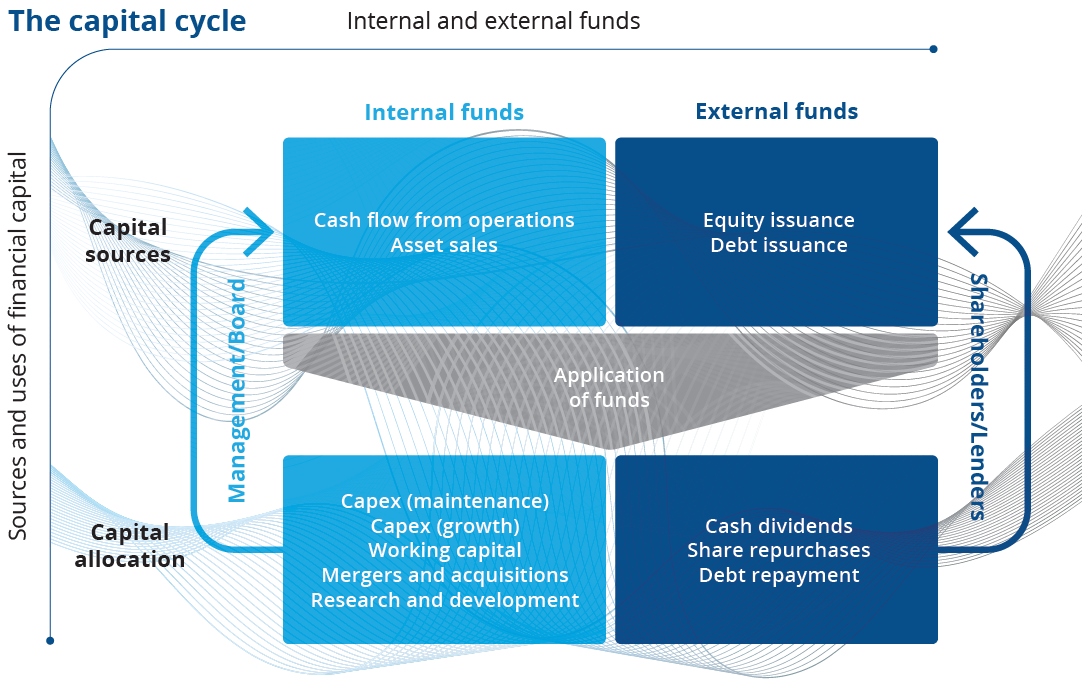
The previous figure shows that the management toolkit for deploying capital comprises five internal alternatives – maintenance capex, growth capex, working capital, mergers and acquisitions, and research and development. It also includes three external alternatives – dividend distributions, share repurchases, and debt repayment.
Our sources of capital comprise two internal alternatives – operational cash flow and asset sales, and two external alternatives – equity and debt issuance.
The risk-adjusted payoff from each capital allocation alternative is likely to differ and continue changing over time throughout the macro, business, and capital cycles. Management is tasked with fully assessing the 'investment' characteristics of each of these levers in terms of risk and return, for the purpose of ranking each in order of priority for allocation decisions.
For each potential alternative allocation of capital, we intend considering at least four key aspects:
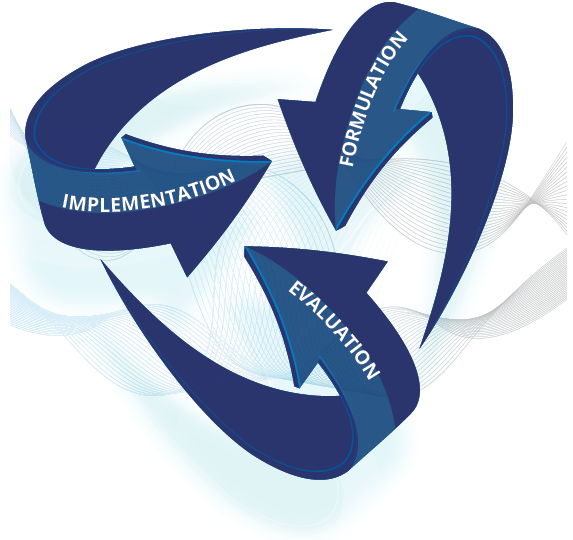
We believe that implementing a Group-wide, disciplined and CEO-driven capital allocation process, incorporating necessary performance feedback to make appropriate adjustments over time, will significantly enhance long-term shareholder value. This circular process is depicted below:
The available capital allocation alternatives in the near term will be somewhat constrained due to the restrictions imposed by the relevant financial institutions on the Group by the Cell C recapitalisation transaction.
In the interim, we will focus our attention on optimising operational cash flows to repay the outstanding debt arising from this recapitalisation. During this time we also intend to complete the development and implementation of the comprehensive Capital Allocation Framework, so that we are ready to resume unrestricted capital allocation activities after the outstanding debt has been repaid.

