

UNLIMITED
POTENTIAL

UNLIMITED
POTENTIAL
The Group delivered a resilient performance in FY26, reflecting the strength of its core businesses. The Remuneration Committee remains committed to ensuring that remuneration outcomes are aligned with performance, shareholder interests and the Group's strategic priorities.
SJ VILAKAZI
Chairman
This report is presented in three sections: Section 1: Annual Statement from the Remuneration Committee Chair, providing context to the Committee's focus areas during the year; Section 2: Remuneration Policy, setting out the governance of remuneration within Blu Label and the forward-looking policy framework; and Section 3: Remuneration Implementation Report, setting out the implementation and outcomes of the remuneration policy for the 2026 financial year.
Dear shareholders,
It gives me great pleasure to present Blu Label's Remuneration Report for the financial year ended 31 May 2026. FY26 has been an important year in the Group's evolution, marked by disciplined execution, meaningful strategic progress and a clearer pathway to sustainable long-term value creation.
A defining feature of the year was the successful restructuring and listing of Cell C, which materially reshaped the Group's investment profile and reduced historic complexity. While the accounting impact of the Cell C transactions created volatility in reported results, these effects are not reflective of the underlying operating trajectory of the business. From a remuneration perspective, the Committee therefore considered performance through the lens of sustainable operational delivery, strategic execution, balance sheet simplification, governance improvements and the quality of earnings, rather than relying solely on reported accounting outcomes affected by once-off restructuring items.
The Group exits this period with a simplified structure, stronger capital base and enhanced earnings visibility. The Board's decision to resume dividend distributions further reflects confidence in the Group's financial position, cash generation and sustainable earnings outlook. In parallel, strategic investments in energy, data analytics, artificial intelligence and digital platforms are moving from development into commercial execution, supported by opportunities such as Blu Energy's participation in South Africa's evolving power sector. These developments reinforce the importance of a remuneration framework that rewards disciplined delivery, supports retention of critical skills and aligns management outcomes with sustainable shareholder value creation.
During FY26, the Committee's workplan was updated to ensure that critical remuneration, nomination and governance matters were addressed through the year, with particular emphasis on ensuring that remuneration remains competitive, fair, responsible and aligned with Blu Label's strategy and performance outcomes. The Committee also focused on shareholder feedback, regulatory developments, succession planning, transformation and the continued refinement of remuneration frameworks to support attraction, retention and sustainable value creation. The Committee received advice during the year from Deloitte and were comfortable that the insight and services received remained objective and independent. The table below summarises the Committee's key focus areas, which were delivered in addition to the standing workplan activities undertaken in accordance with its terms of reference.
| FY26 focus area | Committee emphasis during the year | Outcome |
| Annual workplan and governance cadence | Updated the annual workplan and meeting schedule to reflect the increased complexity of the remuneration environment and the heightened importance of linking remuneration decisions to business performance. | The workplan was adjusted to ensure that critical topics were covered during the year and that the Committee had sufficient time to consider remuneration, nomination and governance matters in a structured manner. |
| Market competitiveness and remuneration trends | Continued to monitor and analyse industry remuneration trends to ensure that Blu Label remains competitive in attracting, retaining and motivating key talent. | The Committee assessed the remuneration frameworks applicable to Disclosed Officers in conjunction with market analysis and concluded that no further major changes were required following changes implemented in FY25 and FY26. |
| Regulatory readiness and disclosure | Monitored relevant legal and regulatory developments, including amendments to the Companies Act relating to executive remuneration disclosure and Board implications. | The Committee prepared for the Companies Act changes implemented late in FY26 and reflected the required considerations in the FY26 remuneration report. |
| Remuneration framework effectiveness | Evaluated the effectiveness of remuneration frameworks and policies, including how best to differentiate between business and employee levels to drive the right outcomes and strengthen the employee value proposition. | The Committee confirmed that the current remuneration architecture remains appropriate, market aligned and supportive of short- and long-term performance, with no major additional changes required for Disclosed Officers. |
| Shareholder and stakeholder engagement | Considered shareholder and stakeholder feedback on the remuneration policy, implementation outcomes and proposed changes to remuneration architecture and metrics. | The Committee engaged with shareholders on feedback received, changes implemented in FY26 and expected FY27 refinements to remuneration architecture and associated metrics, these are detailed out in the following section. |
| Succession planning, transformation and leadership pipeline | Ensured that succession planning across all levels remains appropriate, vibrant and aligned with the need to attract and retain key staff and executives, with a continued focus on transformation. | The Committee continued to support leadership development and human capital interventions aimed at identifying and developing a pipeline of future leaders. |
| Fairness, equity, diversity and inclusion | Monitored remuneration practices for fairness and equity, with emphasis on promoting diversity, inclusion and responsible remuneration outcomes. | Fair pay and pay equity remained an important area of Committee focus and will continue to inform FY27 priorities, including analysis of vertical and horizontal pay gaps as part of the annual workplan. |
| Board and committee composition | Oversaw nomination-related matters, including Board composition, succession planning and the identification and assessment of suitable candidates for appointment. | The Committee recommended new Board appointments during the year following resignations and changes to committee structures, supporting continuity and appropriate governance oversight. |
In summary, the Committee's FY26 activities were directed at ensuring that Blu Label's remuneration and nomination practices continue to remain effective, equitable and aligned with the Group's strategic objectives.
Engagement with shareholders remains a key pillar of the Committee's governance framework. The Committee values the constructive feedback received from shareholders and proxy advisers and has considered this feedback carefully in refining the policy, improving disclosure and balancing the alignment between remuneration outcomes, competitive market-related pay and shareholder value. The Committee also recognises that remuneration outcomes must be read in the context of being competitive and market aligned to attract and retain the right talent, Company performance, dividend policy, capital allocation priorities and the long-term sustainability of the business.
As detailed in our last remuneration report, our policy and its various inputs aligns with best practice and taken together, the Committee believes that the remuneration framework is well aligned with best market practice across the common areas of shareholder concern, including performance periods, incentive simplicity, robust performance conditions, pay quantum, disclosure, discretion, change-of-control protections, ESG integration, vesting caps, dilution, shareholder responsiveness, retention awards and malus and clawback provisions. However, the Committee is equally mindful that good governance requires more than mechanical adherence to market norms, and therefore applies market practice with appropriate judgement and nuance to ensure that Blu Label's remuneration arrangements remain fit for purpose, commercially competitive, performance-led and responsive to the Group's specific strategy, operating context and shareholder value creation objectives.
Specific themes the Committee has reviewed this year after engagement with shareholders are highlighted below as we continually refine where appropriate.

| Feedback theme | Shareholder feedback received | Committee response and impact on policy/disclosure |
| Minimum shareholding requirements | Shareholders requested that the Committee consider whether minimum shareholding requirements should be extended to selected senior management roles below executive director level, taking into account market practice and the depth of LTI participation. | The current MSR requirements for executive directors remain in place and they continue to have shareholdings well in excess of market norms. The Committee will review award levels, LTI participation depth and market practice in FY27 before determining whether broader senior management MSRs are appropriate as this will potentially have broader cost implications with potentially higher awards required to achieve a meaningful MSR. |
| STI and LTI metric definition and disclosure | Shareholders requested disclosure of STI and LTI performance metrics, including the TSR methodology, measurement points and whether a consistent VWAP approach will be applied. | The Committee has enhanced the disclosure approach in the implementation report. The report provides clearer ex-ante disclosure of LTI performance criteria, including TSR methodology and measurement points, and clearer ex-post disclosure of STI outcomes and scorecard performance. |
| STI individual component and alignment with Company performance | Shareholders noted that individual STI outcomes could exceed target even where Company performance does not support above-target outcomes. | The STI architecture remains performance-based, with significant financial weighting and individual balanced scorecards. The Committee will consider introducing a financial gatekeeper so that individual outcomes above target are only achieved where financial performance is at target or better. |
| Target calibration | Shareholders noted the use of a blanket approach to threshold and stretch calibration and encouraged a more nuanced assessment of stretch, achievability and business context. | The Committee will continue to review target-setting methodology and will apply more nuanced calibration where appropriate. |
| HEPS base for LTI targets | Shareholders noted that the HEPS base used for LTI targets should be consistent with the performance level that supported outcomes in the prior year. | The Committee has detailed out the HEPS base applied in the implementation report and ensured that consistency is applied as is evidenced and communicated for the FY25 award and FY26 award with higher Core HEPS starting points. |
| Discretion, adjustments and transparency | Shareholders requested that any future adjustments to reported numbers be applied only in exceptional circumstances, be clearly justified and be fully disclosed. | The Committee has confirmed that discretion and adjustments will only be applied within clearly defined parameters and where justified. It should be noted that in FY25 and FY26, the Committee used discretion to adjust outcomes downward, highlighting that the Committee applies itself to ensure a fair outcome and not an overly formulaic approach to pay. Adjustments will be disclosed with appropriate narrative and applied when relevant. |
| Executive pay, headline earnings and dividends | Shareholders sought clearer articulation of the relationship between executive incentive outcomes, headline earnings, dividend policy and broader shareholder returns. | The Committee will continue to enhance and explain the link between incentive outcomes, and business performance, dividend considerations and capital allocations. As noted in the broader report, the dividends declared in FY26 together with the policy and share repurchase program demonstrate BLU’s commitment to deliver back capital to shareholders through continued execution of its strategic business priorities delivered by management and incentivised through our reward structures. This will support a clearer understanding of pay outcomes in the context of shareholder value creation. |
| Pay gap, fair pay and equal pay disclosure | Shareholders requested clarity on the Group’s approach to pay gap and pay equity disclosures, particularly in light of Companies Act amendments. | The Committee has reported in line with the Companies Act requirements. Pay gap and pay equity analysis will remain a key FY27 focus area. This is detailed in the implementation section. |
| Shareholder engagement | Shareholders encouraged further engagement before the AGM to ensure that the strategy, remuneration outcomes and future policy direction are clearly understood. | The Committee will continue engaging with shareholders ahead of the AGM and will use feedback to refine disclosure and policy implementation where appropriate. |
The Committee also confirms that no significant changes are proposed to the overall executive remuneration architecture for FY27. Variable pay for executives will remain 100% performance-linked through the STI and LTI frameworks, with no increase to target pay levels other than ordinary annual guaranteed pay adjustments. The financial performance weighting of 80% will remain a core design principle for both short- and long-term incentives, with the remaining 20% allocated to balanced scorecard measures, including ESG and strategic milestones. This approach is intended to preserve consistency, strengthen accountability and ensure that value creation for shareholders remains the primary driver of incentive outcomes.
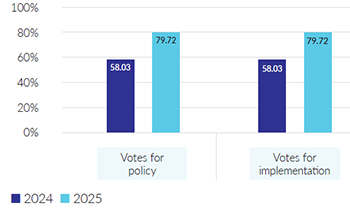
Previous voting outcomes, as highlighted below in the chart, reflect a meaningful improvement in shareholder support and we thank our shareholders for their support as we juxtapose and balance remuneration outcomes, strategic execution and shareholder experience.
While this improvement is encouraging, the Committee recognises that further engagement remains important and will continue to engage with shareholders to ensure that the policy and its implementation remain well understood and appropriately balanced to ensure a relevant and meaningful remuneration EVP.
FY26 reflected continued progress in strengthening the Group's operating platform and positioning it for more sustainable growth. Performance was supported by resilience in core activities, disciplined cost and margin management, and ongoing cash generation. The year also demonstrated further momentum in the Group's strategic shift towards higher-quality, technology‑enabled earnings streams, with management focused on building scalable digital capabilities and deepening the commercial relevance of the Group's platform businesses.
The successful Cell C restructuring and listing was a key strategic achievement, providing greater clarity on the Group's investment exposure and supporting a more transparent assessment of value. The transaction also contributed to a simpler Group profile and improved governance visibility around Cell C as a separately valued listed entity. Given the once-off accounting effects associated with the transaction, the Committee assessed FY26 performance with reference to the quality and durability of operating delivery, progress against strategic priorities and the strengthening of the balance sheet, rather than focusing narrowly on reported earnings volatility.
The Group entered the second half of the year with strong operational momentum, improved earnings visibility and a clearer pathway to medium-term value creation. Core prepaid distribution and payments activities remain resilient, with continued focus on protecting the Group's market-leading position, deepening client relationships, strengthening revenue assurance capabilities and driving disciplined cost and margin management. The resumption of dividend distributions further reflected the confidence in the Group's financial position, cash generation and sustainable earnings outlook.
Strategic investments are also moving from build-out into commercial execution. Blu Energy's progress, including the securing of a multi-year energy trading licence, positions the Group to participate in South Africa's evolving power sector and pursue renewable energy opportunities across municipalities and independent power producers. In parallel, continued investment in data analytics, artificial intelligence and digital platforms supports the Group's ambition to build scalable, technology‑enabled revenue streams. These themes are important in assessing FY26 performance because they demonstrate not only delivery against current-year priorities, but also progress in positioning Blu Label for sustained performance beyond the current financial year.
The Committee remains focused on fair and responsible pay across the Group. The Group's remuneration philosophy continues to aim to attract and retain top talent, reward exceptional ability and expertise, support innovation and high performance, reinforce ethical behaviour and align the interests of shareholders and employees. Executive remuneration remains structured on a total cost to company basis, benchmarked appropriately, with scarce or critical roles considered against a higher market reference point only where appropriate and justified.
In light of the Companies Act amendments, the Committee will continue to enhance its approach to pay gap, fair pay and equal pay analysis. This included selecting a consistent methodology for required disclosures, strengthening internal monitoring and ensuring that the Group has a clear fair pay and equal pay strategy. These matters will remain an important area of focus as disclosure requirements evolve.
The Group has malus and clawback provisions in place to support appropriate risk governance and prevent excessive risk-taking. In determining remuneration outcomes, the Committee applies the remuneration policy and considers carefully whether any discretion is warranted. Any discretion or adjustment is applied only in exceptional and well-justified circumstances, within clearly defined parameters, and is disclosed with appropriate narrative where relevant. Adjustments to performance measures are applied consistently on a like-for-like basis to ensure that management is neither unfairly advantaged nor disadvantaged.
The Remuneration Report has been prepared with reference to the principles of the King V Code on Corporate Governance for South Africa, the applicable requirements of sections 30A and 30B of the Companies Act, as amended, and the JSE Limited Listings Requirements. The Committee remains committed to transparent, fair and responsible remuneration governance, including clear disclosure of the remuneration policy, its implementation during the year and the remuneration outcomes for disclosed officers.
For purposes of the FY26 Remuneration Report, Blu Label has identified the following disclosed officers:
Looking ahead to FY27, the Committee will continue to build on the work completed during FY26, with a focused set of priorities that will be undertaken in addition to its usual annual workplan activities and responsibilities under its terms of reference. These focus areas are intended to ensure that the Group's remuneration and nomination practices remain market competitive, fit for purpose, responsive to shareholder feedback and aligned with Blu Label's strategy, performance outcomes and evolving governance requirements. Key areas of focus for FY27 will include refining remuneration policies and incentive metrics to ensure they remain effective and market competitive, including consideration of the Long-Term Incentive offering for senior management; reviewing the minimum shareholding requirements policy and assessing the appropriate depth of applicability; aligning remuneration reporting with King V and the Companies Act amendments; and continuing to consider shareholder and stakeholder feedback on the remuneration policy, implementation outcomes and related disclosures.
The Committee will also maintain focus on succession planning, transformation and leadership development to ensure that the Group continues to attract, retain and develop key talent across all levels. Fair pay and pay equity will remain an important area of attention, including further analysis of the drivers of vertical and horizontal pay gaps.
We are seeking the following shareholder approvals at the 2026 AGM: approval of the remuneration policy in Section 2; approval of the Implementation Report in Section 3 for the year ended 31 May 2026; and approval of non-executive directors' remuneration through special resolution for the 2027 financial year, as applicable. We are grateful to shareholders for their constructive input over the past year and invite continued engagement before the 2026 AGM on any concerns or questions regarding the remuneration policy, its implementation or the Committee's future areas of focus.
In closing, I would like to thank our shareholders for their continued engagement and constructive feedback, which remain important inputs into the Committee's deliberations. The Committee remains committed to applying sound judgement, maintaining strong governance and ensuring that our remuneration framework continues to support the attraction and retention of critical talent, reward sustainable performance and align management outcomes with the long-term interests of shareholders. We believe our policy and frameworks position Blu Label to continue driving responsible, competitive and performance-led remuneration outcomes in support of the Group's strategy and future growth.
SJ VILAKAZI
Chairman
30 September 2026
Our remuneration philosophy, policy and framework at Blu Label recognise that our people are among our greatest assets. We believe providing an environment where individuals can thrive and grow in their careers while collectively driving the organisation's success is vital. Our remuneration policy and practices aim to foster resilience, drive achievement and cultivate a winning mindset.
We differentiate ourselves from our peers through our EVP and employee engagement strategy. Our "all-in" culture creates a safe environment that enhances productivity and fosters innovation.
Our remuneration policy enables us to:
This applies to all subsidiaries, associates and joint venture companies in which Blu Label holds a shareholding of over 40%, excluding Cell C, which has its own remuneration policy and committee.
Our objective is to be an employer of choice, and our employee brand reward programme are designed to help us achieve this distinction.
We benchmark guaranteed pay practices locally to ensure our remuneration packages are competitive and relevant to the role and experience required.
Deloitte provided a market snapshot for 2026 and these benchmarking exercises are conducted annually to ensure alignment with industry standards and best practices. They are presented to the Committee to determine increases, remuneration quantum and policy adjustments each year.
We are committed to a pay-for-performance philosophy, structuring remuneration to reward both individual and organisational excellence. We apply malus and clawback provisions to the STIP as well as vested and LTIP awards for management.
We strive to ensure employee remuneration differences are based on fair and objective criteria. We continue to build on our pay equity and fair pay analysis undertaken during the year and are compliant with the amendments to the Companies Act and the associated disclosure requirements that are detailed in the implementation report. We remain committed to fostering an inclusive workplace where employees can bring their whole selves to work and live out their purpose. Our strategy remains unchanged in striving for a comprehensive approach focusing on inclusive leadership, retention and employee engagement.
At Blu Label, we adopt a holistic approach to remuneration, incorporating guaranteed pay, variable pay, recognition, employee development and benefits. We understand that the remuneration policy's philosophy and individual components are dynamic and must be reviewed regularly to stay aligned with our objectives and market trends. We ensure full compliance with legislative and regulatory requirements. We provide all employees with clear and transparent information about our reward programmes, policies and processes, ensuring they understand what they receive, why and when.
Annual incentivisation remains directly linked to business plans and budgets for the year in question juxtaposed against individual performance in the role. These business plans are developed by the subsidiary executive committees and reviewed by the Group Executive Committee. Following this, the Blu Label Executive Committee approves the plans with final approval for the Group's consolidated business plan granted by the Board of Directors. Robust targets and metrics are set against each business that look to drive the performance and associated remuneration of employees annually. Long-term incentivisation is linked to the business's long-term performance (three years), measured against key financial, strategic, ESG and shareholder return metrics. These are evaluated annually for relevance driving long-term business outcomes and assisting in retaining and attracting of key skills and employees to our business.
Blu Label's reward framework consists of financial and non-financial components and applies to all employees. The framework includes:
At Blu Label, the pay mix may vary depending on seniority, business needs, such as relocation or international assignment costs and relevant allowances in the execution of specific roles. We reimburse all necessary and reasonable business expenses.
The table below summarises the reward framework for Blu Label.
| Reward element | Purpose and strategic alignment | Eligibility | Performance linkage | Instrument used | Key features |
| Fixed annual remuneration | Attracts and retains employees by providing market-related guaranteed remuneration aligned with role complexity, skills, experience, performance and contribution. Blu Label’s annual salary review process allows management to recognise performance and adjust salaries per market trends and organisational affordability. We aim to differentiate between non-performance, average performance and exceptional performance. | All permanent employees. | Reviewed annually, taking account of individual performance, market positioning, affordability, internal equity and business performance. | Cash remuneration and benefits | Comprises cash salary, medical aid benefits, allowances, and disability and death benefits. Market benchmarks support competitive and fair pay positioning. |
| Sales commissions | Drives continuous improvement, customer service, revenue growth and commercial performance in revenue-generating roles. | Specific roles within sales and operations. | Directly linked to achievement of predetermined sales targets and approved commercial objectives. | Cash commission payments | Variable cash earnings linked to individual and/or team sales performance and paid in accordance with approved commission structures. |
| Short-term incentive plan ("STIP") | Rewards achievement of challenging annual strategic, financial, operational and individual objectives, reinforcing accountability and a high-performance culture. | Eligible executives, management and designated employees. | Assessed annually against a balanced scorecard comprising financial and non-financial measures, including individual key performance indicators. | Cash-based short-term incentive | Annual cash incentive linked to predetermined targets. Supports alignment between employee performance, business outcomes and shareholder interests. We have also utilised special-purpose short-term variable remuneration arrangements designed to attract and retain high-potential talent with scarce skills, offering managers greater flexibility in exceptional cases |
| Special-purpose variable remuneration | Supports the attraction, motivation and retention of employees with scarce, critical or high-potential skills where standard remuneration mechanisms may be insufficient. | Selected critical, scarce-skilled and high-performing employees. | Linked to defined retention, project delivery, business-critical or strategic value creation objectives, together with time-based conditions where applicable. |
Cash-based retention and performance awards | Applied selectively where justified by business need and subject to defined performance, retention and governance conditions. |
| Long-term incentive plan ("LTIP") | Aligns executives and key management with sustainable long-term shareholder value creation while supporting retention of strategically important talent. | Executives and management, subject to approved eligibility criteria. | Measured over a three-year performance period against financial and shareholder-related metrics and non-financial criteria, including ESG and strategic measures. Vesting remains subject to the applicable plan rules and continued employment provisions. | Conditional Share Plan ("CSP"), non-dilutive |
Conditional share awards are granted annually following the relevant governance and approval processes. Awards vest over three years and are settled using shares purchased in the market, making the plan non-dilutive to existing shareholders. |
| Employee value proposition ("EVP") | Enhances employee engagement, wellbeing, development and retention, supporting Blu Label’s position as an employer of choice. | All employees. | Not directly linked to incentive outcomes, although participation supports individual capability, engagement and organisational performance. | Non-financial rewards and employee benefits | Includes learning and development, leadership programmes, recognition, wellbeing initiatives, employee engagement practices and broader benefits that support the employee experience. |
The malus and clawback provisions prevent excessive risk-taking by discouraging executives from misrepresenting Company earnings to inflate variable pay. This provision applies to both vested and unvested "at-risk" remuneration. The Board, based on the Committee's recommendation, may adjust (malus) unvested awards or recover (clawback) vested "at-risk" remuneration if it is determined that an employee has materially contributed to, or is responsible for, the need to restate financial results. This provision does not apply if the restatement is due to changes in accounting standards or interpretations approved by Blu Label's auditors. The CEOs or Company Secretary must notify the Committee and Board chairpersons of any potential 'trigger' events under this policy as soon as practical. The Head of Group Risk and Compliance will notify the Chairpersons if the CEOs or the Company Secretary are involved in the event. Before recommending to the Board any action under the malus and clawback provisions, the Committee will:
Having completed an investigation and following due process, the Board, on advice from the Committee, may decide to claw back, cancel or adjust any vested or unvested STIP or LTIP awards, where they are not satisfied that an award is appropriate or warranted due to exceptional circumstances.
Subject to shareholder approval, the policy set out below will take effect retrospectively from 1 June 2026. It will apply for a period of three years, until the date of the 2029 AGM, unless shareholders approve a revised policy before then. The components of remuneration include:

Greater detail on these remuneration elements is provided below:
| Guaranteed | Variable | ||
| Objective | Fixed annual remuneration | STI | LTI |
| To attract and retain talent, taking into consideration, skills, experience, high potential and value contribution | Reward the achievement of challenging strategic, financial and operational objectives, aligning Executives with company performance and the interests of shareholders. | Aligning Executives to shareholder interests by incentivising performance aligned with strategic goals and long-term shareholder value. | |
| Allocation methodology | Reviewed annually against relevant industry benchmarks to ensure competitive overall remuneration outcomes. | The thresholds and maximum payouts for executive directors are structured as follows: For the CEOs, the threshold is set at 80% of FAR, with a target payout of 100% of FAR, and a maximum payout of 150% of FAR. For the Financial Director, the threshold is set at 50% of FAR, with a target payout at 70% of FAR, and a maximum payout of 100% of FAR. |
Allocation awards for executive directors are currently as follows:
|
| Performance period | N/A | One year | Three years, cliff vest |
| Approach | Adjusted annually to ensure remuneration remains competitive and aligned with the firm policy. | Financial performance will account for 80% of annual measurement with 20% linked to an individual strategic scorecard with associated ratings thereon. Relevant metrics are set each year and aligned to critical strategic and required outcomes for the year in question. Metrics are reviewed continually against the above weighting of pillars (Min. 80% financial) with the FY26-27 metrics shown in the implementation report. | Conditional shares are offered under the 2026 CSP plan.
|
| Plan limits | N/A | N/A | Under the 2026 CSP, there are no plan limits as all awards will be settled with shares purchased off the market. Therefore, the scheme is not dilutive. |
| Termination of employment | No contractual termination benefits or lump sum payments other than typical notice and accrued leave which is paid out in the normal course of business. | STI is payable only to employees who are in active employment in August of the relevant performance year. Employees who have resigned, are serving notice of resignation, or whose employment has been terminated prior to this date, will not be eligible to receive a STI, unless otherwise determined by the Board in accordance with the Good Leaver provisions. | Bad leavers: all unvested awards are forfeited in cases of resignation or dismissal prior to vesting. Good leavers: in cases of retrenchment, death, ill health, disability or any other reason, some or all unvested awards, as the Board may determine in its absolute discretion, shall vest and be settled upon the date of termination of employment. Retirement: Participants shall be entitled to the same rights and be subject to the same conditions as if they had continued to be an employee, unless the Board determines otherwise. |
| Malus and clawback | As detailed in previous section | ||
The Remco conducts formal external benchmarking at least every two years to ensure that the total remuneration (comprising fixed annual remuneration, STI and LTI) remain appropriately competitive and aligned with the Group's performance-based, long-term shareholder value creation philosophy.
The Remco focuses on the overall pay mix reflecting the balance between fixed and variable remuneration and the split between cash and equity remuneration.
The peer group comprises of organisations with a comparable level of business complexity and size. Benchmarks are used as an input into decision-making around pay adjustments and outcomes thereof.
The peer group utilised for FY26/FY27 consists of:
| Adcorp Holdings Ltd | Altron Ltd | Astral Foods Ltd |
| Avi Ltd | Barloworld Ltd | Cashbuild Ltd |
| Famous Brands Ltd | Grindrod Ltd | Hudaco Industries Ltd |
| Lewis Group Ltd | Libstar Holdings Ltd | Metair Investments Ltd |
| Mpact Ltd | Nampak Ltd | Oceana Group Ltd |
| Premier Group Ltd | RCL Foods Ltd | RG Holdings Ltd |
| Sea Harvest Group Ltd | Telkom SA SOC Ltd | Truworths International Ltd |
| Zeda Ltd |

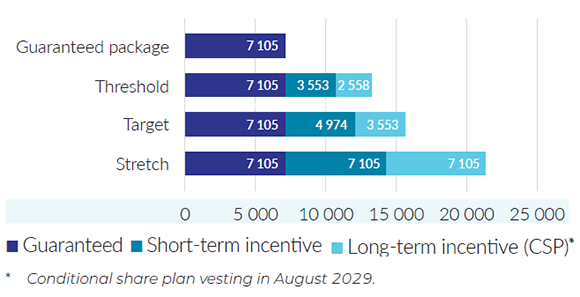
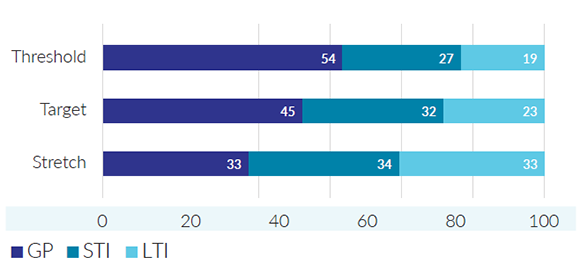
A review of remuneration for disclosed officers was conducted, with no changes proposed to the overall pay mix or target quantums for the year other than the annual inflationary increases provided. The graphs below depict the pay mix for disclosed officers with three performance outcomes, threshold, on-target and stretch performance.
CEOs – R000s – remuneration opportunity

FD – R000s – remuneration opportunity
CEO pay mix (%)
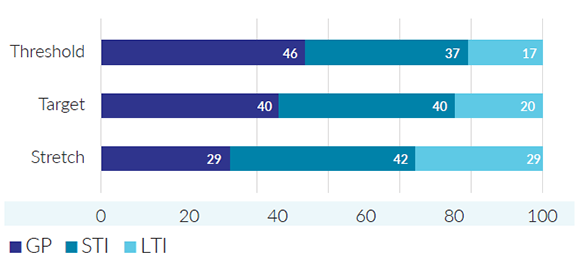
FD pay mix (%)
To align the interests of executive directors with shareholders and promote long-term commitment, executive directors must accumulate a prescribed minimum shareholding within five years from September 2019.
| Role | MSR target |
| CEO | 2 x FAR |
| FD | 1 x FAR |
New agreements were concluded with the executive directors with effect from 5 November 2025, with employment conditions which are comparable to those of other companies in our sector. The salient terms of those agreements are outlined below.
| Term | Condition |
| Contract duration | Three years |
| Restraint period | 12 months |
| Termination benefits | No contractual termination benefits |
| Severance/retirement benefits | No ex-gratia or lump sum payments apply. |
| Unpaid bonus or unvested LTIP | Awards will be treated in accordance with the policy and applicable plan rules and will be subject to Remco and Board oversight and approval in all instances. |

In line with the principles of King V, we maintain a formal Non-Executive Director fee policy which outlines the criteria and structure for their remuneration.
The fee structure is designed to attract and retain individuals with the requisite skills and expertise to provide effective oversight and strategic guidance, while supporting robust governance and sustainable value creation for shareholders. Non-Executive Director remuneration is based on a fixed-fee structure not related to meeting attendance. They receive a retainer for Board membership and for each Board committee on which they serve. Fees are paid quarterly.
The Committee engages with independent third-party advisers to assist with the benchmarking of Non-Executive Director fees against those paid by comparable companies.
Non-executive directors do not receive any performance-related remuneration or any employee benefits.

The following proposed Non-Executive Director fees, for the 2027 financial year, will be tabled for approval by shareholders at the AGM. Refer to special resolution number 1 in the notice of the AGM. The proposed increase of 4% for FY27 aligns with the increase awarded to executive directors.
| Current fee 2026 R |
Proposed fee 2027 R |
||
| SERVICES AS DIRECTORS | |||
| – Chairman of the Board (per annum)1 | 2 531 602 | 658 2161 | |
| – Chairman designate2 (per annum)1 | 668 0622 | 2 000 000 | |
| – Board members (per annum) | 558 442 | 580 780 | |
| AUDIT, RISK AND COMPLIANCE COMMITTEE | |||
| – Chairlady (per annum) | 506 320 | 526 573 | |
| – Member (per annum) | 312 727 | 325 236 | |
| REMUNERATION AND NOMINATION COMMITTEE | |||
| – Remuneration: Chairman (per annum) | 297 835 | 309 748 | |
| – Nomination: Chairman (per annum) | 208 485 | 216 824 | |
| – Member (per annum) | 178 701 | 185 849 | |
| SOCIAL, ETHICS AND TRANSFORMATION COMMITTEE | |||
| – Chairlady (per annum) | 178 701 | 185 849 | |
| – Member (per annum) | 111 689 | 116 157 | |
| AD HOC COMMITTEE | |||
| – Chairman (per meeting) | 67 013 | 69 694 | |
| – Board member (per meeting) | 40 206 | 41 814 |
| 1 | The proposed fee for Mr L Nestadt, pro-rated for three months, amounts to R658 216. The appointment of the new Chairman was effective upon the formal retirement of Mr L Nestadt on 26 August 2026. |
| 2 | Mr LP Ralphs was appointed Chairman designate with effect from 24 February 2026. The amount reflected of R668 062 is the fee actually paid to him for the year ended 31 May 2026, being the Chairman’s annual fee pro-rated for the period. Together with R55 017 for attending a Nomination Committee meeting at the pro-rated Nomination Committee Chairman’s rate, his total fees were R723 079, as reflected on the annual financial statements. The proposed fee for Mr LP Ralphs as Chairman of the board for the 2027 financial year is R2 million. |
The outturns reflected and associated remuneration for the disclosed officers for the financial period FY26 are indicative of the performance and achievements delivered during the year.
The Committee approved an overall increase of 4.75% based on inflationary estimates and market movements and applied increases reflecting key skills set and aligning with our pay-for-performance philosophy. Executive directors received an individual increase of 4%, lower than the approved budget recognising the importance of awarding higher increases at the lower-level employees to continue reducing the pay gap.
The performance metrics and weightings relating to the STIP for the year ended 31 May 2026, were 20% for individual goals and 80% for financial targets. For the joint CEOs, achievement of threshold yields an 80% payout of FAR, target 100% of FAR and a maximum payout at 150% of FAR. For the Financial Director, achievement of threshold yields 50% of FAR, target 70% of FAR and a maximum payout at 100% of FAR.
The Remuneration Committee set the financial and performance targets for FY26 in line with the Board-approved business plan. The key performance metrics included Normalised EBITDA, and Normalised core headline earnings per share ("core HEPS"). The short-term incentive ("STI") bonus is directly linked to these metrics, with:
The joint CEOs successfully delivered against the Group's key strategic priorities during FY2026, overseeing the completion of the Cell C restructuring and listing, which repositioned Cell C as a leaner, independently listed and capital-light operator with a strengthened balance sheet and improved governance framework. The transaction represented the culmination of a multi-year turnaround process and materially simplified the Group's structure. Cell C also demonstrated improved operating performance through subscriber growth, increasing prepaid, postpaid and wholesale revenues, and significantly reduced leverage.
The joint CEOs furthermore led the successful transformation of the Group from Blue Label Telecoms to Blu Label Unlimited Group, establishing a clearer strategic focus around Distribution & Payments, Data Intelligence, Embedded Financial Services and Infrastructure & Energy. This repositioning enhanced the Group's growth profile while maintaining strong cash-generative core operations.
Significant progress was also made in developing future growth platforms. Blu Energy secured a multi-year NERSA energy trading licence, creating a platform for participation in South Africa's energy market, while BluAdvance expanded its market-leading embedded finance platform through an increasing partner ecosystem and broader consumer reach. These initiatives strengthen the Group's medium-term growth prospects and diversify future earnings streams.
In addition to the formal KPIs, the joint CEOs maintained strategic stakeholder relationships, drove innovation across the Group's digital and data capabilities, and provided leadership continuity throughout a period of significant organisational change. The Board considers FY2026 to have been a year of substantial strategic achievement.
The Financial Director played a key role in delivering the Cell C restructuring and listing transaction, including the associated funding, refinancing, balance sheet restructuring and complex financial reporting requirements. The successful completion of these transactions materially simplified the Group's capital structure and enhanced financial flexibility.
Despite the complexity arising from the Cell C transactions, the finance function successfully delivered all interim financial reporting requirements and provided transparent reporting of both statutory and normalised financial performance.
To provide a clearer view of the Group's core performance, normalised financial information has been presented excluding the financial results of Cell C and CEC, all extraneous items arising from the restructuring transactions and the listing of Cell C, and losses on disposal and impairments. Accordingly, the Group reported normalised revenue of R9.4 billion, EBITDA of R923 million, net profit after tax of R677 million and core headline earnings of R681 million, demonstrating the underlying resilience of the business.
Strong working capital management and treasury discipline remained evident throughout the period, supporting positive operating cash generation and an improved liquidity position. Following the successful restructuring, the Board was able to resume dividend distributions, declaring an interim dividend of 43.56 cents per share and a final dividend of 10 cents per share, bringing the total dividend for the year to 53.56 cents per share reflecting confidence in the Group's financial position and future prospects together with the share repurchase programme to return capital to shareholders.
Beyond the formal KPI objectives, the Financial Director continued to strengthen financial governance, capital allocation, stakeholder confidence and reporting transparency during a period of significant corporate activity. Overall, the Financial Director made a substantial contribution to the successful execution of the Group's strategic transformation and balance sheet repositioning during FY2026.
Overall significant strategic performances were delivered over the year against the set milestones and a rating of 3 (on target) was approved for the CEO's and Financial Director.

In assessing the financial components of the FY26 STI performance, the Remuneration Committee measured financial performance against the Board-approved business plan using Normalised EBITDA and Core HEPS, each weighted at 40%.
To ensure a fair and meaningful assessment on the financial components of the STI, the Committee approved the use of normalised results excluding Cell C. This approach was necessary because the acquisition of control, restructuring and subsequent partial disposal of Cell C and ultimate listing gave rise to significant IFRS accounting effects that could not be accurately quantified in the approved FY26 business plan. Excluding Cell C from both actual results and the business plan enabled a better evaluation of underlying operating financial performance for the specific year in question.
(Note – That constraint falls away in the year ending 31 May 2027, for which a budgeted net profit after tax figure for Cell C is available. BLU's share of Cell C's earnings (Core HEPS) can accordingly be measured against that budget and included in the FY2027 measurement against the business plan). The Committee further considered the treatment of certain once-off impairments and disposal losses unrelated to the Cell C transactions. Consistent with a prudent remuneration philosophy, these charges were not added back for STI purposes and remained included in the Normalised EBITDA calculation. As a result, Normalised EBITDA was reduced by R339 million, lowering performance against target and reducing the associated STI outcome. These items did not affect Core HEPS, as they are excluded from headline and core headline earnings calculations.
Accordingly given that the Committee adopted this approach, the following outcomes were approved and summarised in the table on the following page.
The final STI awards reflected the weighted outcome achieved against the Normalised EBITDA and Core HEPS measures, together with the assessment of individual performance objectives.
The Committee concluded that the resulting STI payouts, which were significantly reduced on prior year, appropriately reflected management's strategic delivery and financial outcomes for the year in question.

| METRICS | THRESHOLD | TARGET | STRETCH* | ACTUAL PERFORMANCE AND PRO RATA PAYOUT % ACHIEVED | |
| KPIs (20%) | Individual** | Rating of 2 | Key strategic outcomes for FY26 including individual performance in role – rating of 3 | Outperformed- exception – Rating of 5 |
On-target rating of 3 was approved. All targets relating to individual performance were achieved as outlined in the above narrative. |
| Payout % of FAR | 16% – CEOs 10% – FD |
20% – CEOs 14% – FD |
30% – CEOs 20% – FD |
20% – CEOs 14% – FD |
|
| Normalised EBITDA (40%) |
Group | 20% underperformance against 2026 business plan |
2026 business plan | 20% overperformance against 2026 business plan |
Fell short of threshold. |
| R0.79 billion | R0.99 billion | R1.18 billion | R0.62 billion | ||
| Payout % of FAR | 32% – CEOs 20% – FD |
40% – CEOs 28% – FD |
60% – CEOs 40% – FD |
0% – CEOs 0% – FD |
|
| Core HEPS (40%) | Group | 20% underperformance against 2026 business plan |
2026 business plan | 20% overperformance against 2026 business plan |
Marginally below the targeted business plan for the year FY26. |
| 57.36 (HEPS) | 71.70 (HEPS) | 86.04 (HEPS) | 71.56 (HEPS) | ||
| Payout % of FAR | 32% – CEOs 20% – FD |
40% – CEOs 28% – FD |
60% – CEOs 40% – FD |
39.92% – CEOs 27.92% – FD |
|
| Total payout % of FAR | 80% – CEOs 50% – FD |
100% – Joint CEOs 70% – FD |
150% – Joint CEOs 100% – FD |
Overall outcome 59.92% – CEOs 41.92% – FD |
| # | The bonus is calculated per metric. The value awarded to financial metrics was a weighted average of scores attained versus target and pro-rated applying linear interpolation. |
| * | Performance in excess of target will not automatically result in paying a bonus in excess of target, and the final award outcome is subject to the Committee’s discretion, further subject to the applicable capping at stretch performance. Individual KPI targets are assessed on a balanced scorecard construct. |
| ** | Balanced scorecard construct. |
The scorecard and associated outcomes reflected how the Committee continually reviews and ensures alignment in outcomes and this is evident in the chart below where our payout trends for the executive directors ("EDs") as measured by annual cash incentive quantum's have closely matched our broad performance trends as shown below in the chart.
Annual incentives versus Company performance – five-year indexed trend
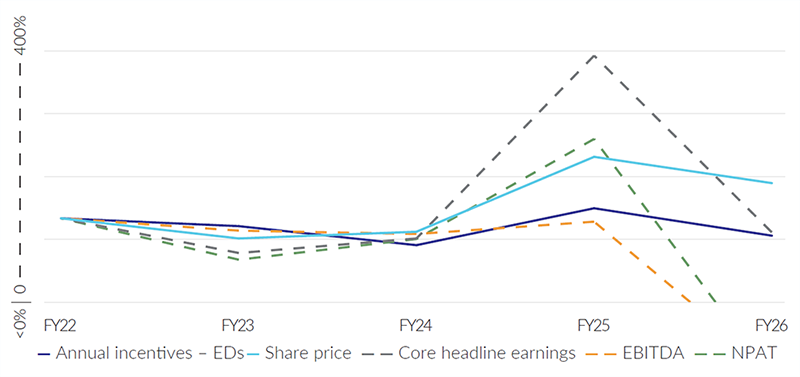
Short-term incentives continue to be measured against the approved business plan for both EBITDA and Core HEPS. A notable change in FY27 is that the business plan for Core HEPS for the short term now includes the expected earnings component for Cell C. The same principles apply with a gate threshold performance being required per metric in order for any incentive to be paid out.
The following table summarises the approach taken for FY27. In the following year's report we will disclose the specific targets and associated outcomes for FY27 much like we have done so for FY26 in this year's report.
| METRICS | THRESHOLD | TARGET | STRETCH* | |
| KPIs (20%) balanced scorecard | Individual** | Rating of 2 (Threshold) | Rating of 3 (Target) | Rating of 5 (Exceptional) |
| Payout % of FAR |
16% – CEOs 10% – FD |
20% – CEOs 14% – FD |
30% – CEOs 20% – FD |
|
| Normalised EBITDA (40%) |
Group | 20% underperformance against 2027 business plan |
2027 business plan |
20% overperformance against 2027 business plan |
| Payout % of FAR |
32% – CEOs 20% – FD |
40% – CEOs 28% – FD |
60% – CEOs 40% – FD |
|
| Core HEPS (40%) | Group | 20% underperformance against 2027 business plan |
2027 business plan |
20% overperformance against 2027 business plan |
| Payout % of FAR | 32% – CEOs 20% – FD |
40% – CEOs 28% – FD |
60% – CEOs 40% – FD |
| * | Performance in excess of target will not automatically result in paying a bonus in excess of target, and the final award outcome is subject to the Committee’s discretion, further subject to the applicable capping at stretch performance. |
| ** | Balanced Scorecard Construct |
The bonus is calculated per metric. The value awarded to financial metrics will be a weighted average of scores attained versus target and pro-rated applying linear interpolation.
Awards are aligned with our policy of being 60% financial, 20% TSR and 20% ESG and strategic. Basis for the awards:
As detailed above, there has been no increase in target award levels other than inflationary linked increases each year attached to the incentive-attracting fixed pay.
| FY25 | INCENTIVE-ATTRACTING PAY (Rm) |
AWARD % PER POLICY |
FY25 AWARD (Rm) |
| CEOs | 12.90 | 50% | 6.45 |
| FD | 6.83 | 50% | 3.42 |
| FY26 | INCENTIVE-ATTRACTING PAY (Rm) |
AWARD % PER POLICY |
FY26 AWARD (Rm) |
| CEOs | 13.42 | 50% | 6.71 |
|---|---|---|---|
| FD | 7.11 | 50% | 3.55 |

| METRIC/WEIGHT | THRESHOLD | TARGET | STRETCH | |||
| Core HEPS | 30% | Group | CPI + 5% | CPI + 7% | CPI + 9% | |
| Compounded cumulatively over three years | Vesting % | 21.6% | 30% | 60% | ||
| ROCE | 30% | Group | ROCE ≥ WACC over three years | ROCE ≥ WACC + 1% over three years | ROCE ≥ WACC + 2% over three years | |
| Compared to WACC over three years, not compounded** | Vesting % | 21.6% | 30% | 60% | ||
| Relative TSR | 10% | Group | = J201 mid-cap index | = J201 average + 3% | = J201 average + 6% | |
| Relative to JSE mid-cap index (J201)*** | Vesting % | 7.2% | 10% | 20% | ||
| Absolute TSR vs. CoE | 10% | Group | TSR = CAGR vs CoE | TSR = CAGR vs CoE+ 1% | TSR = CAGR vs CoE+ 2% | |
| Measured against cost of equity**** | Vesting % | 7.2% | 10% | 20% | ||
| Strategy and ESG balanced scorecard | 20 % | Group | Rating 2 (Threshold) | Rating 3 (Target) | Rating 5 (Exceptional) | |
| Strategy and ESG-focused measure***** | Vesting % | 14.4% | 20% | 40% |
Core HEPS: Core headline earnings per share for this award assumes a normalised starting point of 139.51 cents being the 71.56 cents of normalised Blu Label Core HEPS and Blu Label share of Cell C normalised associate earnings of 67.95 cents. The new stretching targets assume a 49.53% share of forward looking earnings of Cell C. The much higher targets than the previous award reflect the expected accretive growth over the three‑year period. If Blu Label's shareholding in Cell C reduces, the stretching targets will be adjusted accordingly.
ROCE** is calculated using the following formula:
ROCE = (Net operating profit (EBIT) + associate earnings)/Capital employed. Capital employed = total assets – current liabilities (excluding interest-bearing borrowings). The committee will review any prior year impairments to assess if adverse outcomes have occurred, and if so, make the necessary adjustments to the capital employed number such that the average performance is a more accurate indication to shareholders over the measurement period.
TSR*** Performance against the index:
**** Cost of equity ("COE"):
***** Strategy and ESG-focused balanced scorecard.
The 20% of our scorecard pertaining to strategy and ESG is evaluated each year and adjusted.
The Committee may review metrics and targets for future awards to ensure they are relevant. The LTIP is calculated per metric. All financial metrics will be assessed and vest on a pro rata basis applying linear interpolation basis. The key pillars and associated indicators pertaining to ESG, which we will track, are set out on the next page.
| METRIC PILLAR | METRIC DESCRIPTION | ||
| B-BBEE AND EMPLOYMENT EQUITY | 15% | B-BBEE scorecard improvement Female representation at middle and senior management Employment Equity Plan delivery |
|
| YOUTH LEARNERSHIPS AND JOB READINESS | 25% | Learner enrolment Programme completion rate Learner absorption rate |
|
| INTERNAL TALENT DEVELOPMENT, PROMOTION AND DIVERSITY | 20% | Diverse new hires Women in leadership representation within Top and Senior Management relative to males Promotions from internal equity candidates Talent retention Succession coverage and EE successor depth |
|
| RURAL DIGITAL CONNECTIVITY AND FINANCIAL INCLUSION | 20% | Annual LTE (4G) subscriber acquisition Prepaid Fibre access to the home: annual active subscribers SMEs activated and equipped with Business in a box opportunities |
|
| GOVERNANCE | 20% | Timeous reporting of non-compliance incidents following identification and investigation Implementation of mandatory cybersecurity controls to ISO 27001 via annual certification Data breaches and Information Regulator enforcement |
The table overleaf summarises the outcomes related to the long-term incentive awarded covering the period 1 June 2023 to 31 May 2026. The following are the associated scorecard, performance and vesting outcomes:

| Long-term incentive plan (2023 Conditional share plan) Performance metric |
Threshold 72% |
Target 100% |
Stretch 140% |
Actual performance outcome |
Actual performance vesting % |
Moderated outcome |
Final vesting % |
| Metrics | |||||||
| Core HEPS (30%) compounded cumulatively over three years | CPI 118.19 cents |
CPI + 2% 125.14 cents |
CPI + 4% 132.35 cents |
139.51 - Stretch | 45% | Target | 30% |
| ROCE (30%) compared to WACC over the three-year period, not compounded | ROCE ≥ WACC 15.35% |
ROCE ≥ WACC + 1% 16.35% |
ROCE ≥ WACC + 2% 17.35% | ROCE 14.80% Below threshold |
0% | Below threshold |
0% |
| Strategic performance balanced scorecard (20%) | Linked to strategic milestones | Linked to strategic milestones | Linked to strategic milestones | Target achieved | 20% | Target | 20% |
| ESG (10%) | Pro rata of target | Specific ESG metrics | No stretch | At or above target in all three years | 10% | Target | 10% |
| Individual KPIs (10%) | Pro rata of target | Specific | No stretch | Target achieved | 10% | Target | 10% |
| Total vesting % related to performance conditions for the 2023 conditional share plan | 85% | 70% |
The LTIP is calculated per metric. The value awarded to financial metrics is the weighted average of scores attained against target. All financial metrics are assessed and vest on a pro rata basis applying linear interpolation. ESG and individual KPIs cannot vest above target, as reflected in the vesting percentages above. Further detail on the outcomes of the scorecard are provided on the following page.
| BM Levy | MS Levy | DA Suntup | |
| 2023 INITIAL AWARD VALUE (R’000) AT R3.22 | 5 851 | 5 851 | 3 099 |
|---|---|---|---|
| Share price at award date 1 September 2023 (R) | 3.22 | 3.22 | 3.22 |
| Number of shares awarded | 1 817 001 | 1 817 001 | 962 354 |
| Vesting outcome % | 70% | 70% | 70% |
| Number of shares to vest | 1 271 901 | 1 271 901 | 673 648 |
| 2023 AWARD VALUE EXCLUDING SHARE PRICE APPRECIATION (R’000) AT R3.22 | 4 096 | 4 096 | 2 169 |
| Share price at 31 May 2026 (R) | 9.19 | 9.19 | 9.19 |
| Share price appreciation to 31 May 2026 | +185% | +185% | +185% |
| Award appreciation to 31 May 2026 (R’000) | 7 593 | 7 593 | 4 022 |
| 2023 award value as at 31 May 2026 (R’000) at R9.19 | 11 689 | 11 689 | 6 191 |
The Committee's final determination on the 2023 long-term incentive award was based on a careful assessment of the performance metrics set at the time over the three-year performance period from FY23 to FY26.
The Committee concluded that the FY26 endpoint should include Blu Label's share of Cell C's earnings, but only after removing the once-off accounting consequences arising from the Cell C recapitalisation, acquisition of control, restructuring and subsequent listing. The objective was to assess underlying economic performance on a like-for-like basis rather than allowing exceptional IFRS accounting outcomes to either inflate or suppress the result.
The calculation was therefore derived from Blu Label normalised Core HEPS for FY26 of 71.56 cents plus Blu Label's share of Cell C earnings after normalisation adjustments. This is shown succinctly below:
| NORMALISED CORE HEPS CALCULATION | FY26 |
| Blu Label normalised Core HEPS (excluding Cell C) (cents) | 71.56 |
|---|---|
| Cell C reported net profit | R4.16bn |
| Less: restructuring, recapitalisation (loan write offs etc) and listing-related items | (R3.02bn) |
| Cell C normalised net profit1 | R1.14bn |
| Blu Label share of Cell C normalised earnings2 | R614.7m |
| Blu Label share of Cell C HEPS contribution (cents) | 67.95 |
| Normalised Core HEPS – end FY26 (cents) | 139.51 |
| 1 | Cell C’s normalised earnings exclude transaction costs, debt restructuring impacts, lease termination gains and losses, IFRS 2 adjustments and other exceptional items arising from the recapitalisation and listing. Marketing support fees and recapitalisation discounts incurred by Cell C and received by TPC were not added back to avoid potential double counting of value already recognised elsewhere within the Group. |
| 2 | The calculated amount included in the normalised numbers reflected an effective interest of 70% June to August 2025, 80.13% September to November 2025 and 49.53% December 2025 to May 2026). |
As Cell C returned to profitability and ultimately listed independently, that value creation warranted consideration in the incentive outcome on a fair and normalised core basis and the Committee concluded that it was reasonable to exclude extraordinary restructuring and listing impacts, reflect core sustainable earnings rather than accounting volatility and ensure the numbers would form the basis for future awards (much like last year where the 271 cents in FY25 formed the starting point of the award for that LTIP). This is summarised below for reference.
| Year ended 31 May | BLU normalised Core HEPS (cents) |
BLU share of Cell C normalised associate earnings (cents) |
Calculated Core HEPS (cents) |
| 2023 (base year for 23-26) | 104.83 | – | 104.83 |
| 2024 (base year for 24-27) | 68.66 | – | 68.66 |
| 2025 (base year for 25-28) | 99.84 | 171.11 | 270.95 |
| 2026 (base year for 26-29) | 71.56 | 67.95 | 139.51 |
Using the normalised methodology, Core HEPS exceeded the stretch hurdle established when the award was granted. On this basis, the mathematical outcome under the plan rules supported stretch vesting on the Core HEPS metric, equivalent to a 45% contribution.
Although the normalised result technically exceeded the stretch hurdle, the Committee also recognised that the outcome was dependent on normalisation adjustments relating to Cell C. The Committee therefore considered whether awarding the full stretch outcome would overstate the overall outcomes and accordingly, the Committee exercised discretion and determined that while management should receive credit for the final successful execution of the Cell C strategy, the outcome should be moderated downward. Rather than allowing the Core HEPS measure to vest at the full stretch level of 45%, the Committee reduced the vesting outcome to target at 30%.
The final vesting outcome for the Core HEPS component produced a more balanced remuneration result while still recognising the successful delivery of the Group's long-term Cell C strategy coming to fruition.
It should also be noted that this number will be the base for which the latest awards will be evaluated from and not the lower Group Core HEPS outcome for FY26, ensuring that future awards are not measured from a soft starting point. In addition, as denoted in the FY26 awards table, more stringent targets have been applied for this award in terms of growth against this target to reflect the trajectory that is expected on the inclusion of Cell C in FY27 and beyond.
The Committee considered the remaining performance measures as an important counterbalance to the Core HEPS outcome. The ROCE measure, which represented 30% of the award opportunity, was assessed against the Group's weighted average cost of capital over the three-year period. Although FY26 ROCE of 16.42% exceeded the FY26 cost of capital of 14.14%, the three-year average ROCE of 14.80% remained below the three-year average WACC of 15.35%. This metric resulted in nil vesting. This outcome demonstrates that the framework continued to operate as intended, with management not being rewarded for capital deployment that did not fully exceed the Group's cost of capital over the performance period.
The strategic scorecard, representing 20% of the award opportunity, vested at target. In reaching this conclusion, the Committee considered the successful delivery of a number of significant strategic objectives, including the completion of the Cell C restructuring and subsequent listing, the realisation of value from the Group's long‑term investment in Cell C, continued covenant and liquidity management during a period of substantial corporate activity, growth within the core distribution businesses and the successful entry into the energy market through the awarding of a multi-year energy trading licence to Blu Energy. While these achievements were substantial and transformational in nature, the Committee considered that target vesting appropriately reflected performance against the predetermined strategic milestones established at the commencement of the award cycle.
The ESG scorecard, representing 10% of the award opportunity, vested at target. The Committee noted that the Group achieved at or above target performance across all three years of the measurement period, including the maintenance of B-BBEE credentials, continued investment in youth employment and skills development, improvements in diversity and inclusion outcomes, advancements in rural connectivity and financial inclusion initiatives, and strong governance outcomes, including cybersecurity and compliance performance. In accordance with the scheme rules, no stretch opportunity was available under this metric and achievement at or above target therefore resulted in full target vesting.
The individual performance measure, representing the final 10% of the award opportunity, also vested at target. The Committee considered the successful delivery of key executive and management objectives throughout the performance period, including the execution of the Cell C restructuring and listing, the repositioning of the Group as Blu Label Unlimited Group, portfolio rationalisation activities and the establishment of new growth platforms. The Committee was satisfied that management had delivered the objectives set at the outset of the award cycle and that target vesting appropriately reflected this performance.
Together, these measures contributed 40% vesting and reflected the Committee's view that management had delivered strongly against the Group's strategic, operational and stakeholder objectives.
Overall, the vesting outcome of 70% vs 100% at target and 140% at stretch reflected a balanced outcome against the achievements over the period in question.
The background to the 2023 award is important as it was measured against a framework developed during a period in which a significant proportion of management focus was directed towards the stabilisation, restructuring and ultimate value realisation of Cell C. With that strategic chapter now substantially complete, the performance framework has evolved.
As outlined in the remuneration policy and reflected in the design of future awards, the balance of performance measures has shifted materially towards shareholder returns, strategic execution and sustainability outcomes through the inclusion of relative and absolute TSR measures and a combined strategy and ESG scorecard. This evolution reflects the Committee's view that Blu Label has successfully turned the corner on the Cell C journey and that future incentive outcomes should increasingly reward sustainable shareholder returns, disciplined capital allocation and the delivery of long-term value across the Group's broader portfolio of growth opportunities.

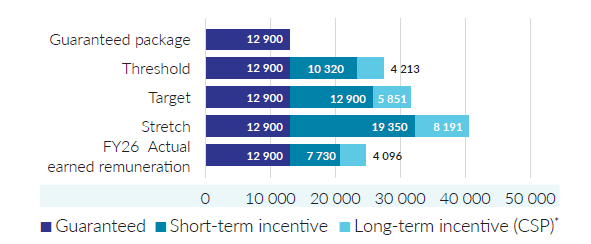
The charts below illustrate total earned remuneration in relation to varying potential scenarios as defined in our policy.
The detailed tables of remuneration disclosure are based on the Institute of Directors in South Africa ("IoDSA") and South African Reward Association ("SARA") application guidance on remuneration disclosure in accordance with King V and presents the remuneration for the Disclosed Officers of Blu Label. The comparative information has been presented in a manner consistent with the current year's presentation.
CEOs – R'000 – remuneration outcomes
FD – R'000 – remuneration outcomes
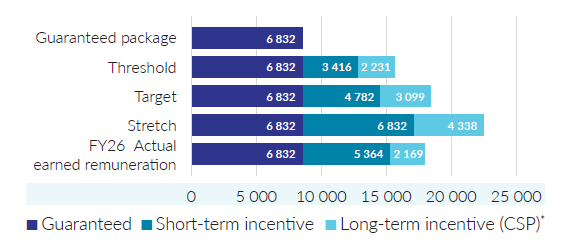
* The long-term incentive (CSP) opportunities and outcomes in the above tables relates to the 2023 scheme excluding share price appreciation.
| Executive directors’ remuneration for the year ended 31 May 2026 | Explanatory notes |
BM Levy R’000 |
MS Levy R’000 |
DA Suntup R’000 |
Total R’000 |
| Fixed remuneration | 12 900 | 12 900 | 6 832 | 32 632 | |
|---|---|---|---|---|---|
| Short-term incentive bonus | 1 | 7 730 | 7 730 | 5 364 | 20 824 |
| 2023 conditional share plan | 2 | 11 689 | 11 689 | 6 191 | 29 569 |
| Gross dividends applicable to the 2023 conditional share plan | 3 | 681 | 681 | 361 | 1 723 |
| TOTAL EARNED REMUNERATION | 33 000 | 33 000 | 18 748 |
| 1. | Based on performance for the financial year ended 31 May 2026. Included in DA Suntup’s short-term incentive bonus was a once-off amount of R2.5 million awarded in recognition of his involvement in the pre-listing restructuring transactions and the subsequent listing of Cell C Holdings Limited on the JSE in November 2025. |
| 2. | In terms of the 2023 conditional share plan, 1 271 901 shares vested to BM Levy and MS Levy and 673 648 shares to DA Suntup, included in the above table at a 31 May 2026 share price of R9.19. |
| 3. | An interim dividend of 43.56 cents per share and a final dividend of 10 cents per share, resulted in a total dividend for the year amounting to 53.56 cents per share. |

| Executive directors’ remuneration for the year ended 31 May 2025 | Explanatory notes |
BM Levy R’000 |
MS Levy R’000 |
DA Suntup R’000 |
Total R’000 |
| Fixed remuneration | 12 404 | 12 404 | 6 569 | 31 377 | |
| Short-term incentive bonus | 1 | 15 157 | 15 157 | 5 400 | 35 714 |
| 2022 conditional share plan | 2 | 9 849 | 9 849 | 5 216 | 24 914 |
| TOTAL EARNED REMUNERATION | 37 410 | 37 410 | 17 185 |
| 1. | Based on performance for the financial year ended 31 May 2025. |
| 2. | BM Levy, MS Levy and DA Suntup were restricted from trading in the Company’s securities as a result of the proposed restructure of the Group. Accordingly, the shares under the 2022 conditional share plan vested when such restrictions lapsed. In terms of the 2022 conditional share plan, 831 134 shares vested to BM Levy and MS Levy and 440 200 shares to DA Suntup, included in the above table at a 31 May 2025 share price of R11.85. |


No payments were made on employment termination to any executive management members during the financial year ended 31 May 2026.
| Issue date | Issue price R |
Vesting date | Awards outstanding as at the beginning of the year |
Number of shares awarded during the year |
Awards forfeited during the year |
Awards vested during the year |
Balance as at the end of the year |
Fair value at 31 May 2026 R’000 |
|
| CONDITIONAL SHARE PLAN | |||||||||
| FOR THE YEAR ENDED 31 MAY 2026 | |||||||||
| Executive directors | |||||||||
| BM Levy1 | 6 April 2022 | 6.42 | 24 November 2025 | 578 521 | – | – | (578 521) | – | – |
| BM Levy1 | 1 September 2022 | 6.25 | 24 November 2025 | 874 878 | – | (43 744) | (831 134) | – | – |
| BM Levy | 23 October 2023 | 3.22 | 31 August 2026 | 1 817 001 | – | – | – | 1 817 001 | 16 698 |
| BM Levy2 | 27 November 2025 | 4.93 | 31 August 2027 | – | 1 257 969 | – | – | 1 257 969 | 11 561 |
| BM Levy2 | 28 November 2025 | 12,35 | 31 August 2028 | – | 522 256 | – | – | 522 256 | 4 800 |
| 3 270 400 | 1 780 225 | (43 744) | (1 409 655) | 3 597 226 | 33 059 | ||||
| MS Levy1 | 6 April 2022 | 6.42 | 24 November 2025 | 578 521 | – | – | (578 521) | – | – |
| MS Levy1 | 1 September 2022 | 6.25 | 24 November 2025 | 874 878 | – | (43 744) | (831 134) | – | – |
| MS Levy | 23 October 2023 | 3.22 | 31 August 2026 | 1 817 001 | – | – | – | 1 817 001 | 16 698 |
| MS Levy2 | 27 November 2025 | 4.93 | 31 August 2027 | – | 1 257 969 | – | – | 1 257 969 | 11 561 |
| MS Levy2 | 28 November 2025 | 12,35 | 31 August 2028 | – | 522 256 | – | – | 522 256 | 4 800 |
| 3 270 400 | 1 780 225 | (43 744) | (1 409 655) | 3 597 226 | 33 059 | ||||
| DA Suntup1 | 6 April 2022 | 6.42 | 24 November 2025 | 306 407 | – | – | (306 407) | – | – |
| DA Suntup1 | 1 September 2022 | 6.25 | 24 November 2025 | 463 369 | – | (23 169) | (440 200) | – | – |
| DA Suntup | 23 October 2023 | 3.22 | 31 August 2026 | 962 354 | – | – | – | 962 354 | 8 844 |
| DA Suntup2 | 27 November 2025 | 4.93 | 31 August 2027 | – | 666 269 | – | – | 666 269 | 6 123 |
| DA Suntup2 | 28 November 2025 | 12.35 | 31 August 2028 | – | 276 607 | – | – | 276 607 | 2 542 |
| 1 732 130 | 942 876 | (23 169) | (746 607) | 1 905 230 | 17 509 |
| 1 | As reported in the prior year, the vesting, transfer and/or sale of certain share awards to BM Levy, MS Levy and DA Suntup had been restricted by a closed period in terms of the JSE Listings Requirements. This closed period expired on 24 November 2025. Following its expiry, the shares awarded on 6 April 2022 and 1 September 2022 vested on 24 November 2025 and were transferred to the respective directors. These shares are accordingly no longer restricted or included in treasury shares at year-end. |
| 2 | The 2024 and 2025 share awards, which had not previously been allocated to BM Levy, MS Levy and DA Suntup as a consequence of the closed period, referred to above, were awarded following its expiry – the 2024 awards on 27 November 2025 and the 2025 awards on 28 November 2025. |
| Issue date | Issue price R |
Vesting date | Awards outstanding as at the beginning of the year |
Number of shares awarded during the year |
Awards forfeited during the year |
Awards vested during the year |
Balance as at the end of the year |
Fair value at 31 May 2025 R’000 |
|
| CONDITIONAL SHARE PLAN | |||||||||
| FOR THE YEAR ENDED 31 MAY 2025 | |||||||||
| Executive directors | |||||||||
| BM Levy3 | 6 April 2022 | 6.42 | 31 August 2024 | 803 501 | – | (224 980) | – | 578 521 | 6 855 |
| BM Levy | 1 September 2022 | 6.25 | 31 August 2025 | 874 878 | – | – | – | 874 878 | 10 367 |
| BM Levy | 23 October 2023 | 3.22 | 31 August 2026 | 1 817 001 | – | – | – | 1 817 001 | 21 531 |
| BM Levy4 | 19 November 2024 | 4.93 | 31 August 2027 | – | – | – | – | – | – |
| 3 495 380 | – | (224 980) | – | 3 270 400 | 38 754 | ||||
| MS Levy3 | 6 April 2022 | 6.42 | 31 August 2024 | 803 501 | – | (224 980) | – | 578 521 | 6 855 |
| MS Levy | 1 September 2022 | 6.25 | 31 August 2025 | 874 878 | – | – | – | 874 878 | 10 367 |
| MS Levy | 23 October 2023 | 3.22 | 31 August 2026 | 1 817 001 | – | – | – | 1 817 001 | 21 531 |
| MS Levy4 | 19 November 2024 | 4.93 | 31 August 2027 | – | – | – | – | – | – |
| 3 495 380 | – | (224 980) | – | 3 270 400 | 38 754 | ||||
| DA Suntup3 | 6 April 2022 | 6.42 | 31 August 2024 | 425 565 | – | (119 158) | – | 306 407 | 3 631 |
| DA Suntup | 1 September 2022 | 6.25 | 31 August 2025 | 463 369 | – | – | – | 463 369 | 5 491 |
| DA Suntup | 23 October 2023 | 3.22 | 31 August 2026 | 962 354 | – | – | – | 962 354 | 11 404 |
| DA Suntup4 | 19 November 2024 | 4.93 | 31 August 2027 | – | – | – | – | – | – |
| 1 851 288 | – | (119 158) | – | 1 732 130 | 20 526 |
| 1 | Although 578 521 shares vested to BM Levy and MS Levy and 306 407 shares vested to DA Suntup during the year, the transfer and/or sale of these shares were restricted due to a closed period in terms of the JSE Listings Requirements. The shares were transferred once the closed period expired. The shares were included in treasury shares and management concluded that no agency relationship exists over the shares while these rights were restricted. |
| 2 | The 2024 share awards were not allocated to BM Levy, MS Levy and DA Suntup due to them being placed in a closed period. The shares were awarded once the closed period expired. |
The MSR policy required employees to obtain the required target holding levels within five years. The table below outlines the current holding as at 31 May 2026 against target.
| Role | Participant | MSR Target | Current holding as multiple of FAR |
| CEO | BM Levy | 2 x FAR | 51.76 |
| MS Levy | 2 x FAR | 46.49 | |
| FD | DA Suntup | 1 x FAR | 9.06 |
Blu Label is committed to remunerating fairly, responsibly and transparently; in line with the Companies Act requirements on pay disclosures, the section below outlines our approach to analysis and disclosures for FY26.
In conducting the analysis of fair and responsible pay disclosures, the sample utilised comprises permanent salaried employees who were employed for the full financial year under review. This provides a more accurate and meaningful comparison of remuneration within the Company's core workforce. Total gross remuneration is defined as all earnings processed through the payroll, during FY26, including base salary, allowances, employer contributions to retirement and benefit funds, other benefits in kind and short- and long-term incentive awards, where applicable. The application of the above criteria ensures that the population reflects employees with a full period of service and remuneration. Remuneration figures are comparable across individuals, and the disclosed metrics are not skewed by atypical working patterns, incomplete service periods or inconsistent data.
Tabulated below are the workforce metrics for FY26, incorporating the above definitions and methodology.
| Total Earned Remuneration Ratios | |
| Highest earner | R36.5M |
| Lowest earner | R77.4K |
| Median of all employees | R495K |
| Average of all employees | R990K |
| Top 5%/bottom 5% ratio (Calculated on total remuneration of top 5%/bottom 5%) | 75.3 : 1 (75.3x) |
These disclosures are intended to provide stakeholders with greater transparency regarding pay equity and internal pay differentials within the Company.
In line with the Non-Executive Director policy, the following remuneration was paid during FY26:
| NON-EXECUTIVE DIRECTOR | 2026 R’000 |
2025 R’000 |
|
| LM Nestadt* | 3 115 | 2 635 | |
|---|---|---|---|
| H Masondo | 1 075 | 764 | |
| NP Mnxasana | 1 122 | 1 006 | |
| RD Mokhobo | 897 | – | |
| LE Mthimunye | 1 559 | 1 404 | |
| LP Ralphs** | 723 | – | |
| SJ Vilakazi | 1 584 | 1 476 | |
| JS Mthimunye*** | 430 | 1 439 |
| * | Resigned 26 August 2026. |
| ** | Appointed 24 February 2026. |
| *** | Resigned 29 August 2025. |
The Remuneration and Nomination Committee is satisfied that the remuneration and reward policy has been complied with for the year under review, insofar as disclosed officer remuneration is concerned.


BLU Label Unlimited Integrated Annual Report 2025