
Year
Logo

UNLIMITED

POTENTIAL

Our business model

INPUTS

Financial capital

  • Equity capital
  • Debt capital
  • Working capital
  • Capital expenditure: R615 million (excluding Cell C: R391 million)

Manufactured capital

Property, plant and equipment to the value of R141 million (excluding Cell C: R69 million), including:

  • R19 million vending machines and terminal devices;
  • R51 million (excluding Cell C: R31 million) computer and office equipment;
  • R6 million media equipment;
  • R7 million motor vehicles;
  • R39 million (excluding Cell C: R6 million) leasehold improvements; and
  • R19 million (excluding Cell C: Rnil) Cell C network assets

Intellectual capital

  • Additions to intangible assets: R304 million (excluding Cell C: R152 million)
  • Software development spend: R170 million
  • Market insight and data
  • Entrepreneurial culture and agile practices
  • Operating systems, policies, processes and procedures
  • Reporting and communication
  • Proprietary technology, software and IT systems
  • Targeted analytical processes, machine learning and artificial intelligence ("AI")

Human capital

  • Employees: 1 025
  • Salaries and benefits spend: R1.267 billion (excluding Cell C: R1.015 billion)
  • Experienced Board, executive and senior management
  • Performance management system
  • Leadership development programme

Social and relationship capital

Relationships with all stakeholder groups, including:

  • Employees, customers, shareholders, government, regulators, partners, suppliers and media
  • SED spend: R12.5 million

Natural capital

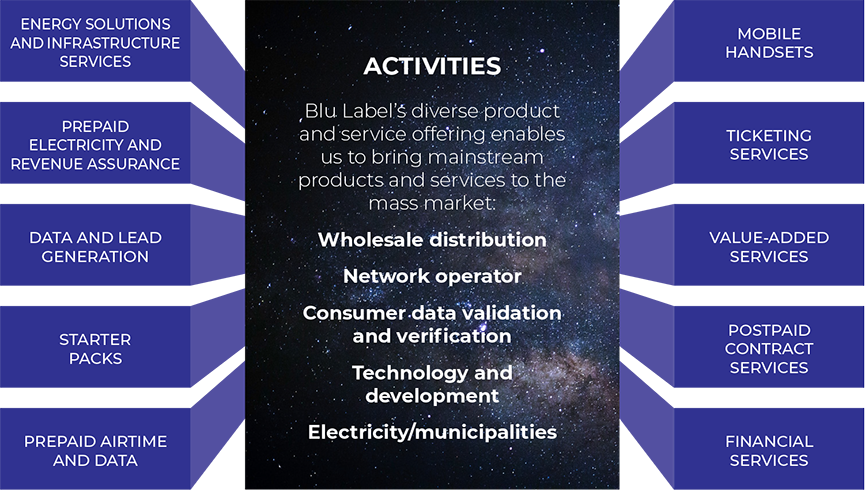
OUTPUTS: OUR PRODUCTS AND SERVICES

Blu Label's resources are divided into six capitals by the <IR> Framework, which considers how an organisation's operations and results impact or change these resources. We weigh the trade-offs between the various value drivers and every choice we make aims to maximise benefits and minimise drawbacks.
OUTCOMES

A strong balance sheet and sufficient working capital to fund the operations that support long-term sustainability

  • Revenue: R13.1 billion (excluding Cell C: R10.6 billion)
  • Gross profit: R3.5 billion (excluding Cell C: R2.2 billion)

Economic benefits for stakeholders:

  • Investing activities: R1.5 billion (excluding Cell C: R286 million) inflow
  • Lease payments: R765 million (excluding Cell C: R21 million)
  • Taxes paid: R141 million (excluding Cell C: R113 million)
  • Employee salaries and benefits: R1.267 billion (excluding Cell C: R1.015 billion)
  • Ability to deliver valuable services and solutions in response to changing consumer demands
  • Strategically located outlets offering convenient customer access to products and services
  • Proprietary systems/solutions add value and secure sophisticated contracts
  • Accelerating our digitisation projects to fast-track our ability to be responsive to our new environment
  • Improved responses to changing consumer needs
  • Brand reinforcement and market communication
  • Accelerated deployment of new technologies
  • Effective controls and processes
  • Creative solutions increase productivity, cost savings and synergies
  • Building an organisation that is future fit, an inclusive business with a growth mindset
  • Employee wellbeing is part of our strategy to succeed
  • Employee engagement is more centred around creating meaningful jobs and creating an environment that creates purpose
  • A vibrant, diverse and flexible workforce committed to the long-term success of Blu Label:
    • 48% female;
    • 89% of recruits are black; and
    • 75% appointed in managerial roles are black.
  • Inclusive leadership that promotes innovation, teamwork and job satisfaction
  • Building sustainability programmes that impact communities and youth development
  • Initiatives aimed to build entrepreneurs and SMMEs
  • Supporting flagship beneficiaries that align with our shared socio-economic values through the Trust Blu Foundation
  • Business efficiency through collaboration with producers and suppliers
  • Building trust and respect
  • Social relevance in the communities we operate in
  • Brand reinforcement and market communication
  • Sustained confidence from shareholders and investors
  • We are aware of the environmental impacts of our operations and activities. We pursue the responsible management of waste and emissions, with a focus on the sustainable use of our resources
  • Blu Label views digital products and services as having significant potential to deliver positive environmental outcomes

TRADE-OFFS

Short-term investment vs long-term benefit

An essential trade-off between short and long-term investment is associated with financial capital.

It is important to balance the interest of short-term benefits with those of long-term sustainable growth objectives. While both are important for different stakeholders at different times, they are also key to our strategic decision-making process.

Automation and human capital

Automation of routine tasks through technology may reduce human capital in the long term. Blu Label's approach is to find value-creating opportunities in new and evolving technologies that support our employees and our communities in their work.

Fast-paced innovation

Our technical innovation and entrepreneurial drive are central to effectively serving the unbanked market segment and those without access to technology.

The adoption of new technologies, as well as processes and systems that are faster and more efficient, requires effective change management with employees and subsidiaries.

Responding to social and environmental issues

Climate change is increasingly in the spotlight as the effects of global warming start to show up in severe weather events worldwide. At the same time, social challenges and inequality are thrown into sharp relief, especially in developing countries. In choosing where to allocate Blu Label's financial resources to improve the world, we consider solving social issues focusing on our material suppliers' value chains.

Our business model and the use of the capitals to create value for all our stakeholders are underpinned by robust corporate governance, as outlined on ESG reporting index.