Remuneration report
DEAR SHAREHOLDERS
It has been a busy year for the Remuneration Committee. We have engaged actively with institutional shareholders to address concerns expressed with our policy. Our aim is to fortify relationships with our shareholders through aligning interests which is achieved through honest dialogue and an understanding of our remuneration practices and how they will be applied within the organisation.
Working with our Human Capital team we have engaged external advice and support to address these concerns and bring our policy closer to best practice of fair and responsible remuneration aligned to shareholder interests and value creation. In the revision of our policy we have partnered with business to ensure that the policy is fit for purpose and is aligned to the operational strategy and the talent requirements of Blue Label.
In choosing which financial metrics to use in STIs and LTIs, we have benchmarked against our peers, considered best practice, and more importantly incorporated the specific business goals of Blue Label. It is important to ensure consistency and a meaningful analysis of performance.
When considering an appropriate peer group, we gave consideration to the industry sector, the size of comparator companies, the complexity of the business, the extent of international operations and talent considerations (companies from which individuals might be recruited or to where individuals might be lost). We aimed to choose a peer group that is robust and would allow for a fair reflection of our performance over a period of time, which allows a fair unencumbered measure of performance in returning value to shareholders in comparison to alternative investments shareholders could have made.
This report has been drafted in accordance with the requirements of King IV. We have divided the report into three sections:
-
Background statement regarding committee considerations and decisions
-
Our remuneration philosophy, policy and framework
-
Implementation and remuneration disclosure of the prescribed officers (joint CEOs and CFO) and Non-Executive Directors (NED).
Section 1 provides an overview of how the Remuneration Committee has championed our alignment to King IV's Code on Corporate Governance and how we have aimed to address institutional shareholder concerns with changes to our policy. Section 2 summarises our revised remuneration philosophy and policy, together with an overview of our revised total rewards strategy that will be a key focus area for Blue Label in FY20. The full policy can be accessed here. Finally, Section 3 provides an overview of FY19 performance and discloses payments made to Executive Directors during the year in terms of performance against targets, as well as the fees paid to Non-Executive Directors.
Looking forward to FY20, we will implement and anchor our new reward philosophy and policy across the Group. We will continue to champion the pay for performance principle and ensure that the revised policy is aligned to our business strategy and growth agenda and deliver total shareholder returns. The Human Capital team will continue to expand our total reward philosophy, in line with our broader employee value proposition #HappinessisBlu. We trust that our holistic and considered approach will enable us to align our talent to shareholder interests, while differentiating us within the marketplace and enabling us to attract and retain talent.
We invite you to give us your views on our revised policy and its implementation looking forward. We would like to thank everyone who engaged with us through the year and provided valuable input and who have ultimately enabled us to align further to all of our stakeholder requirements. We are mindful that during the year under review, the Group performance and resulting impact on our share price, has been hugely disappointing. The Executive Directors have consequently waived any entitlements to STI bonuses for this financial year. We acknowledge that we are on a journey of moving Blue Label closer to best practice and remain committed to this.
GD Harlow
Chairman of the Remuneration Committee
SECTION 1
Background statement regarding committee considerations and decisions
The Blue Label board and Remuneration committee endeavour to apply the King IV principles regarding responsible and transparent remuneration practices. During the year, the Remuneration Committee have actively engaged with the Board, Deloitte, KPMG, Korn Ferry and various shareholders, to comprehensively review our remuneration strategy and supporting policy. We are confident that the new remuneration policy will align shareholder and management objectives while also providing for employee attraction and retention.
The review was undertaken to:
- Address institutional shareholders feedback and concerns,
- Enable Blue Label to compete within an increasingly competitive talent market, through bringing us closer to best practice fair and transparent remuneration practices;
- Enable us to attract and retain key capabilities and talent required to deliver our growth strategy;
- Align employee performance and value-creating behaviours to our strategy and delivering shareholder returns.
We engaged with the various stakeholders during and after the implementation of the changes. At the end of the engagements, key decisions were taken to review how we positioned ourselves to comparator groups within the South African general market and identified peers to make changes to our short-term and long-term incentives. Our revised remuneration philosophy and policy, demonstrates our desire to move us closer to best practice and maintain our competitiveness within the market.
Bringing us closer to best practice fair and transparent remuneration practices:
King IV™ guides organisations to apply remuneration practices which are fair, responsible and transparent. The Committee has engaged with shareholders and external advisers to bring us closer to best practice.
In summary the following amendments have been made to our remuneration practices:
- created a new total reward philosophy for Blue Label Telecoms;
- revised our remuneration philosophy and policy and engaged consistently with key stakeholders though the process;
- in revising the policy we:
- aim to achieve a more favourable split between fixed and variable pay over time, taking us closer to a 35% fixed and 65% variable split;
- are positioning our fixed pay at market median as opposed to the upper quartile;
- will upweight variable pay and pay for performance;
- have revised our targets for our STIP and LTIP and removed the outperformance bonus from our policy;
- have introduced a new malus and clawback clause; and
- have introduced special short-term incentives to enable us to attract and retain critical skills which are key to our strategy.
Further details can be found in section 2 of the report and the full Remuneration Policy which can be accessed here.
Attracting and retaining key capabilities and talent required to deliver our growth strategy:
In FY18 we saw an increase in staff turnover within Blue Label, particularly within our IT division. As with other organisations, we have had to compete for key skills and high potential talent within an environment where the demand and supply forces of certain skills resulted in management offering remuneration that was on occasion higher than the average remuneration offered to current employees. We have responded in a holistic approach through reviewing our Blue Label talent strategy, talent management practices, and standardising our grading and remuneration practices across the Group.
In FY19 we have:
- updated our talent strategy and implemented new talent management processes;
- engaged Deloitte, the Korn Ferry Hay Group and KPMG to understand what our strengths are as an organisation and where we could improve our remuneration practices;
- revised our total reward framework to create a compelling and competitive employee value proposition that speaks to all employee generations and life cycles, thereby aiming to increase engagement and maintain our high-performance Blue Label culture;
- reviewed our grading and embarked on systematically aligning the organisation across all entities to Hay grades and the newly defined Blue Label bands through updating job descriptions;
- completed a benchmarking process to review our internal pay scales, align the organisation and have begun to consistently apply them to all new appointments;
- been guided by our internal pay scales, when drafting offers for new appointments, and aim to offer packages targeted at the market median, taking into consideration individual criteria, such as availability of skill within the market, employee experience, qualifications, leadership skills and technical competencies;
- conducted an equal pay for equal work assessment, with regard to gender and race, to understand our pay practices across the Group and found that no bias exists within our business based on race and gender, where there is equal representation. The bigger issue that needs to be addressed is female representation and equity representation in Senior Management and Top Management; and
- begun to address pay inequity across various bands and roles where job content has expanded through our growth strategy.
As demonstrated, we have responded in a holistic approach to compete effectively through a total reward philosophy that is fair and transparent and that aims to engage the hearts, hands and minds of our talent.
Aligning employee performance and value-creating behaviours to our strategy and delivering shareholder returns:
In consultation with our institutional shareholders and taking cognisance of our strategy, we have revised our metrics to align employee performance to value-creating behaviours and shareholder returns. In consultation with our Remuneration Committee, Social and Ethics Committee and Group Risk Management Committee, we have revised our metrics to:
- reward delivery of NPAT for Senior Management;
- retain core HEPS growth for Senior Management at Group level and Executive Directors as a key metric;
- introduce EBITDA for senior management at Group level and Executive Directors;
- introduce return on capital employed as a new key metric to ensure an appropriate capital allocation policy is implemented and delivered against; and
- introduce TSR (total shareholder return) targets for our LTIP scheme.
In addition we:
- removed the retention element of our LTIP and replaced it with an ESG performance scorecard, further aligning us to King IV;
- introduced minimum holding requirements for Executive Directors; and
- introduced malus and clawback provisions.
The revised policy and metrics are effective for FY20.
Additional decisions taken in FY19:
- Updated the Remuneration and Nomination Committee Terms of Reference.
- Updated the Remuneration Policy.
- Set performance conditions for short and long-term incentives for FY19 for Executive Directors.
- Approved increases and adjustments for executives, Senior Management and employees.
- Evaluated the LTIP vesting conditions for the 2015 scheme and approved final vesting ratios.
Specifically, addressing institutional shareholder concerns:
Following the results of the non-binding advisory vote on the 2018 remuneration policy, we encouraged and received feedback from various institutional shareholders through the year regarding our policy and the implementation thereof. Specifically, the Chairman of the Remuneration Committee conducted both written and face-to-face meetings with Sanlam, Old Mutual, Allan Gray and Aeon. Engagement with these institutional shareholders allowed us to distil key areas of concern. We have taken steps to address them in a pragmatic and affordable manner and incorporated the required changes in the new remuneration policy. We summarise:
| |
Key themes |
|
Assessment and rescommendations by certain shareholders |
|
Amendments to the Blue Label Telecoms remuneration policy |
| |
Fixed annual remuneration (FAR) in proportion to total remuneration is too high for Executive Directors of BLT. |
|
ASSESSMENT
The split between FAR and performance variable remuneration (Short-term Incentives (STIs) and Long-term Incentives (LTIs)) is skewed towards the Short-term Incentive plan (STIP) and FAR because target pay-outs for the Long-term Incentive plan (LTIP) are too low.
Our CFO's total on-target single figure remuneration is below the market median, with fixed pay only marginally above the median.
The joint CEOs total on-target single figure remuneration is at the market median, with FAR at the upper quartile. Total remuneration is skewed towards the STIP and FAR.
In addition, the benchmarking process was skewed by the dramatic fall in the market capitalisation of BLT without taking into consideration that the CEOs also play a significant role in driving the recapitalisation and new strategy of Cell C.
The Executive Directors do not earn any Non-Executive Director fees from Cell C.
RECOMMENDATIONS
- For our CEOs, the current overall on-target single figure total remuneration should remain the focus and Remco can be comfortable that this is in line with the median. Should the founding CEOs leave the company, then BLT should align the pay mix with market practice, resize the job and pay mix with a more traditional view and mix across fixed pay and variable pay.
- Adjust the overall remuneration by paying at the market median for fixed pay and increase cap on STIP and LTIP to bring BLT closer to aligning pay mix and on-target single figure remuneration.
|
|
We aim to leverage our remuneration policy to attract and retain competent executives and talent into Blue Label, reward them fairly in a way that is consistent with their performance, and align the incentives for these executives with the best interests of shareholders.
We have a unique business in that our CEOs are founding members of the organisation and are significant shareholders. This ties them to the long-term success of the company. Further increasing the cap within the LTIP to provide for slightly more shares will not significantly alter their motivation or drive performance. However, while they are in our employment, we will ensure that we incentivise and reward them to deliver against the interests of our institutional shareholders.
The following amendments have been made:
- The outperformance bonus has been removed and we adjusted caps on STIs and LTIs to improve the pay mix and bring us closer to best practice.
- Pay mix has been reviewed and adjusted for Executive Directors increasing variable pay proportion and adjusting the mix between STIPs and LTIPs.
Joint CEOs:
- STIP on-target payout has been reduced from 120% to 100% of FAR. A maximum payout of 150% has been introduced.
- LTIP on-target share allocation has been increased from 35% to 50% of FAR. A maximum share allocation of 70% has been introduced.
CFO:
- STIP on-target payout remains at 70% of FAR. A maximum payout of 100% has been introduced.
- LTIP on-target share allocation has been increased from 35% to 50% of FAR. A maximum share allocation of 70% has been introduced.
Senior management:
- STIP on-target payout remains at 50% of FAR. A maximum payout of 75% has been introduced.
- LTIP on-target share allocation has been increased from 18% to 25% of FAR. A maximum share allocation of 35% has been introduced.
|
| |
|
|
|
| |
Retention shares are being paid to Executive Directors with no performance conditions. |
|
ASSESSMENT
Retention of the CEOs is key to the firm's success and the restraint of trade payment (a concern raised by shareholders) across three years to cover a further three years after termination of their employment, addresses this.
That said, a removal of the retention element in the LTIP is warranted.
RECOMMENDATIONS
An ESG performance scorecard should replace the retention element, aligning BLT even further with King IV and removing the large retention element of pay. |
|
The retention element within the LTIP has been replaced with an ESG performance scorecard that will be linked to our strategy and operational requirements. 20% of the LTIP will be linked to the ESG performance scorecard.
100% of the LTIP is now linked to performance measures (both financial and non-financial). |
| |
Long-term rewards should drive governance and long-term shareholder value. |
|
RECOMMENDATIONS
- Remove the retention element.
- Use of relative TSR measure versus an absolute one.
- Limit duplication of metrics across STIP and LTIP.
The following metrics were suggested, all with an equal 33.3% weighting:
- Growth in core HEPS compared to CPI plus a premium (with varying targets and thresholds);
- Total shareholder return versus a selected market peer Group;
- ESG Performance scorecard (environmental, social, governance) that is weighted average across selected metrics.
Value awarded should be weighted average of scores attained versus target. |
|
Blue Label remains committed to aligning our LTIP to shareholder interests through incentivising performance in line with strategic goals and long-term shareholder value. In addition, the plan will be structured to retain human capital with scarce or critical skills.
In response to our assessment we have:
- Removed the retention element within our LTIP and the outperformance bonus; and
- Increased the LTIP cap to drive and reward outperformance.
From 1 September 2019, the following metrics will apply:
- 30% of the allocation will be linked to cumulative growth in core HEPS compared to CPI plus a premium;
- 30% will be linked to total shareholder return (TSR) versus the JSE Capped All Share Index (i.e relative outperformance is required);
- 20% will be linked to return on capital employed; and
- 20% will be linked to a predefined ESG performance scorecard (environmental, social, governance).
We chose a broad market index as opposed to a selected peer group as there are only five other listed entities in the telecommunication sector, and the Group operates in other sectors as well. |
| |
Minimum shareholding requirements are not in place within the current scheme. |
|
RECOMMENDATION
Minimum shareholding requirements for management should be implemented. |
|
The policy has been updated to further align management's interests directly with those of shareholders and to encourage long-term commitment to the organisation. Executive Directors and Prescribed Officers will be required to accumulate a minimum holding of share allocations from 1 September 2019.
- Joint CEOs will be required to accumulate two times FAR over a period of five years. Our joint CEOs own a significant part of Blue Label and we will continue to review this.
- The CFO will be required to accumulate one times FAR over a period of five years.
|
| |
It is not clear what the malus and clawback provisions are. |
|
ASSESSMENT AND RECOMMENDATION
While there is a clawback policy currently in place, it does not include and detail, malus/clawback provisions as pertaining to any award in terms of the remuneration policy. |
|
We have integrated a malus and clawback clause into the revised remuneration policy. It is designed to be preventive rather than a purely remedial or punitive measure and removes the incentive for executives to consider deliberately misstating company earnings to inflate variable pay. The clause applies to both the STIP and LTIP.
The Board may act on the recommendation of the remuneration committee to adjust (malus) or recover (clawback) vested and unvested "at risk" remuneration paid or payable under the STIP and LTIP, where there is reasonable evidence that a Blue Label employee has materially contributed to, or been materially responsible for, the need for the restatement of financial results for reasons including:
- Personally, acting fraudulently or dishonestly or in a manner that adversely affects the Company's reputation, or which is characterised as gross misconduct.
- Directing an employee, contractor or adviser to act fraudulently, dishonestly or to undertake other misconduct.
- Breaching their material obligations to Blue Label, through error, omission or negligence.
- Receiving a STIP or LTIP award because of fraud, dishonesty or a breach of obligation committed by another person.
- Receiving a STIP or LTIP award because of an error in the calculation of a performance measure.
This policy will not apply in the case of a restatement of financial results caused by a change in applicable accounting standards or interpretations thereof, provided originally approved by the Company's auditors. |
| |
Concerns raised about the use of core HEPS as the only financial performance hurdle factor for the STIs and LTIs. |
|
RECOMMENDATION
Metrics chosen should drive the achievement of Blue Label's long-term objectives, as well as address any concerns highlighted by shareholders.
- Core HEPS should be retained given that Blue Label is an entrepreneurial growth company. It is a metric that has short and long-term applicability and that management has control over in meeting financial performance targets.
- Apply TSR versus peer group as a transparent metric to review relative value creation and shareholder return.
- ROE will ensure an appropriate capital allocation policy is implemented.
- Apply EBITDA as a financial metric as opposed to core HEPS.
|
|
With regard to concerns about the use of core HEPS, the only adjustment made to HEPS to determine core HEPS is the add back of the amortisation of intangible assets as a consequence of purchase price allocations in terms of IFRS 3(R), thus demonstrating the true operational performance of the BLT Group.
In determining growth in core HEPS, cognisance of extraneous income and expenditure in both the comparative and current year will be taken into account by the REMCO.
Applying EBITDA only as a financial metric, does not factor in the impact on earnings relating to the cost of strategic gearing, to contributions from associates and joint ventures and to depreciation and taxation. The Group is strongly focused on growth in earnings and not just at EBITDA level.
The following financial measures will be applied in determining the STIP for Group head office and Executive Directors:
The following financial measure will be applied in determining the STIP at divisional level:
The following financial measures will be used within our LTIP:
- core HEPS;
- total shareholder return compared against the JSE Capped All Share Index; and
- return on capital employed.
|
VOTING AT THE 2019 ANNUAL GENERAL MEETING (AGM)
In line with the Companies Act and King IV, we will table the following resolutions for shareholders voting at the AGM:
- Advisory vote for the approval of the revised remuneration policy for implementation in FY20;
- Advisory vote for FY19 implementation report which is governed by our previous remuneration policy; and
- Binding vote on Non-Executive Directors' fees.
Shareholder votes in favour
REMUNERATION AND REWARD POLICY
REMUNERATION OF NON-EXECUTIVE DIRECTORS
Shareholders are invited to engage on our new remuneration policy and this remuneration report by sending a request for engagement to the Chairman of the Remuneration Committee to investors@blts.co.za.
Remuneration committee focus areas for FY20:
The Board has mandated the Remuneration Committee to continually assess the executive remuneration market and governance frameworks. Given the current South African economic environment and Blue Label's strategy and operational performance, we anticipate the following focus areas for the year ahead:
- Monitor the implementation of the revised remuneration policy across the organisation to demonstrate our commitment to attracting and retaining critical skills and talent.
- Continue to champion the fair and responsible pay of our talent, support the transformation agenda and eliminate any unfair bias or practices.
- Monitor and assess the remuneration landscape within South Africa, particularly relative to other telcos and similarly sized organisations.
- Review of our peer group applicable to the LTIP.
- Non-Executive Director benchmarking assessment.
- Alignment of metrics to value creating behaviour and hence shareholder interests, and rewarding performance accordingly.
- Assessing who our prescribed officers should be as an outcome of our current organisational re-design.
- Attracting female black talent onto our Board of Directors for BLT.
SECTION 2
Blue Label recognises that our talent is a critical enabler to us achieving our aspirations and strategic goals. Our remuneration policy and practices, together with our Employee Value Proposition (EVP) of #HappinessisBlu aims to differentiate us from our peers. Through our remuneration policy and employment practices, we aim to:
- create shareholder value by aligning our remuneration practices to our strategic goals;
- achieve new employment equity targets;
- align our employees' performance with shareholder interests;
- support our talent strategy through enabling Blue Label to attract, motivate and retain the very best calibre of directors and employees who have above-average industry ability and expertise;
- create an entrepreneurial, competitive, innovative and high-performance company through rewarding demanding performance goals that are consistent with our strategy and shareholder growth expectations;
- achieve our employment equity targets; and
- reinforce our desired culture through encouraging and rewarding ethical behaviour that is consistent with our values and leadership behaviours, thereby stimulating employee engagement and corporate citizenship simultaneously.
The competitive talent landscape, within which Blue Label operates, demands a differentiated reward system that is capable of competitively matching pay for results and which can be executed fairly and without bias.
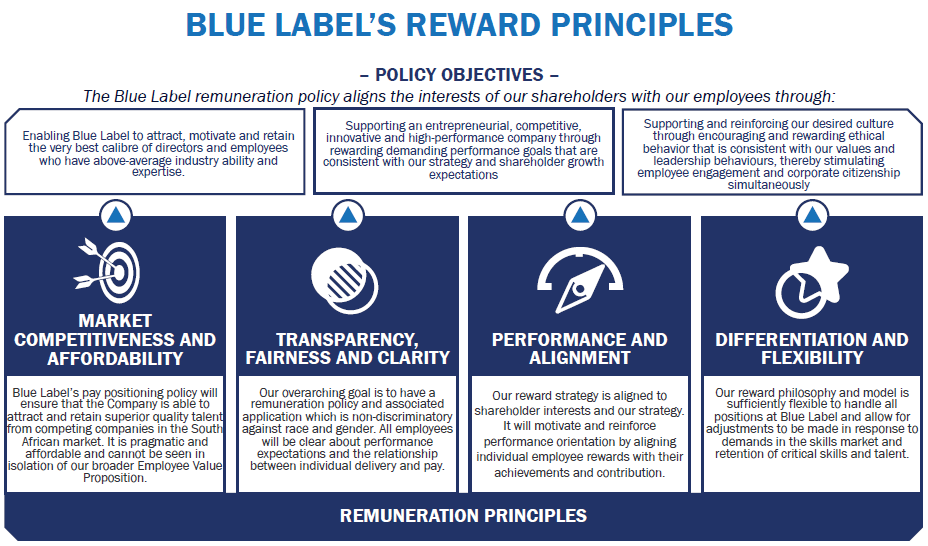
To create a progressive and yet pragmatic remuneration policy, we have applied the following design principles:
- market competitiveness and affordability;
- transparency, fairness and clarity;
- performance and alignment; and
- differentiation and flexibility.
This policy applies to all subsidiaries, associates and joint venture companies in which the Group holds a shareholding in excess of 40%, excluding Cell C who have their own remuneration policy and committee. Furthermore, it applies uniformly in all such jurisdictions, except where it conflicts with either local statutes or regulations, in which case such statutes or regulations will apply. Where an operating jurisdiction has a more onerous regulatory or statutory framework, the local standards of governance in that jurisdiction will apply. The Remuneration Committee may approve by exception, for the policy to apply to seconded Blue Label employees.
At Blue Label we subscribe to a total reward philosophy. Fixed remuneration includes cash and benefits. When combined with incentive payments and awards and other non-quantifiable elements, they make up the Blue Label Total Rewards Plan. The components of the Blue Label employee remuneration and reward plans are:
- fixed annual remuneration (FAR);
- short-term incentives (STI);
- long-term incentives (LTI);
- commissions for sales staff;
- ad hoc rewards for performance and behaviours linked to our values, leadership programmes and competitions;
- non-financial benefits aligned to our EVP #HappinessisBlu;
- Blue Label pays additional benefits when specific business circumstances require it, including costs and allowances related to relocation and international assignments; and
- we reimburse all necessary and reasonable business expenses.
| |
|
|
|
|
BLUE LABEL TALENT STRATEGY
| |
|
|
| |
|
|
|
|
| |
|
|
Fixed annual remuneration
|
| Sales commissions |
|
Short-term Incentive Plan |
|
Short-term variable remuneration |
|
Long-term Incentive Plan |
|
#HappinessisBlu |
|
|
| OBJECTIVES |
|
Enables us to attract and retain talent, taking into consideration, skills, experience, high potential and value contribution. |
|
Aligned to drive continuous improvement, improved customer service and increased revenue in sales and operations. |
|
Reward the achievement of challenging strategic, financial and operational objectives, aligning individuals to divisional, Group performance and the interests of our shareholders. The scheme is structured to reward collaborative work across the Group to ensure we leverage our capabilities, increase innovation, improve customer and consumer service, reduce inefficiencies and increase revenue and profits. |
|
Special-purpose variable remuneration arrangements to help attract and retain high potential talent who are the holders of scarce skills. Arrangements are subject to individual performance and time-based conditions to ensure an appropriate return on the remuneration investment. |
|
Aligning employees to shareholder interests through incentivising performance in line with strategic goals and long-term shareholder value. |
|
Create a differentiated employee value proposition and work experience to increase the engagement and retention of existing employees and position Blue Label as an employer of choice within an increasingly competitive landscape. |
|
| |
|
|
|
|
|
|
|
|
|
|
|
|
|
|
|
| ELIGIBILITY |
|
All |
|
Specific roles within sales and operations. |
|
All |
|
- Critical and scarce skills
- High-performing employees with high potential and critical skills
|
|
Executives and management |
|
All |
|
| |
|
|
|
|
|
|
|
|
|
|
|
|
|
|
|
| FY20 APPROACH |
|
Weighted average increase of up to 6%. |
|
As defined by the operational plan and budget. |
|
Schemes with varying components linked to:
- individual performance;
- divisional performance (where applicable); and
- Group performance.
Gatekeeper conditions are in place. Individual metrics are limited to five KPIs and must be verifiable and challenging. The following financial measures will be applied in determining the STIP for Group head office and Executive Directors:
The following financial measure will be applied in determining the STIP at divisional level:
CEO's thresholds are calculated at 80% of FAR, target at 100% of FAR and a maximum pay-out at 150% of FAR.
FD threshold is calculated at 50% of FAR, target at 70% of FAR and a maximum pay-out at 100% of FAR.
Further details on targets can be found in the full remuneration policy. |
|
Cash-based signed-on awards and retention bonuses are assessed on a case-by-case instance in line with policy.
Further details on targets can be found in the full remuneration policy. |
|
Schemes available.
Eligibility based on:
- senior leadership;
- talent key to driving business strategy;
- retention of talent with high potential and/or critical skills; and
- transformation objective.
Gatekeeper conditions are in place.Awards are subject to malus and clawback provisions.Minimum holding requirements are in place for Executive Directors.From 1 September 2019 the following metrics will apply:
- core HEPS compounded cumulatively over three years.
- total shareholder return versus the all share capped index.
- return on capital employed.
- ESG performance scorecard.
Allocation awards for Executive Directors looking forward are:
- 50% of FAR for the CEOs with a maximum of 70%; and
- 50% of FAR for the FD with a maximum of 70%.
Further details on targets can be found in the full remuneration policy. |
|
Individualised employee engagement, development and growth. |
|
BLUE LABEL HIGH PERFORMANCE
In our assessment of our current remuneration practices we have noted that we need to increase our pay for performance through variable pay. The Remco is working closely with management through the application of this policy and our Blue Label remuneration and talent management strategy, to move towards a pay mix of 35% fixed annual remuneration and 65% variable annual remuneration for Executive Directors and senior management for on-target performance. Variable annual remuneration will be equally split between STIs and LTPIs. This will bring us closer to best practice and will enable us to balance attracting and retaining high potential human capital with creating long-term value for our shareholders. This is a three-year goal.
Fixed Annual Remuneration
Fixed Annual Remuneration is a critical enabler in the attraction and retention of human capital, taking into regard skills, experience, high potential and value contribution. The components of guaranteed fixed remuneration are:
- cash salary;
- medical aid benefits;
- allowances; and
- disability and death benefits.
Any changes to benefit contribution levels are cost neutral to the Group.
Consideration is given to local market conditions and FAR, and total annual remuneration is benchmarked against independent market data. We have revised our policy and we aim to pay at the median of the general South African market. We are transitioning to the Hay Grading Methodology across the group and each graded role reflects the scope and depth of role, experience required and level of responsibility. An acceptable earnings range is allocated to each role. In limited instances, salaries above the market median may exist due to historical factors or where we have aimed to attract or retain high potential human capital, with above-average experience or critical skills.
In line with equal pay for equal work, every effort is made to ensure internal equity (between race, gender and grade) within the Group. The policy is flexible and allows for management discretion to consider consistent high-performance, high potential human capital, above-average experience or critical skills within an increasingly competitive talent market place. Where any remuneration levels are not market-related or reflect internal inequity as per our grading and recommended pay scales, an appropriate adjustment can be made. In addition, management may motivate to the CEOs, Group Head of Human Capital and Remco, for senior management and executives remuneration adjustments, within reason, to retain above-average experience, high potential human capital or critical skills.
Annual salary review process
Blue Label's annual salary review process provides an opportunity for management to reward for performance and adjust salaries in line with market increases and organisational affordability. Blue Label's annual performance-based increases are affected in June each year. We aim to differentiate between non-performance, average performance and exceptional performance. A pool of allocated budget linked to inflation is distributed amongst employees. In FY20 the Remco mandated an average increase of up to 6%. All increases above 6% were reviewed, moderated and approved by the CEOs and Remco where appropriate. To qualify for an annual increase in June, employees must have been employed by Blue Label for six months.
Short-term Incentive Plan
Within our revised policy we have extended our Blue Label STI plan to additional bands within our grading framework. Looking forward, STIs will reward the achievement of strategic, financial, and operational objectives. In line with our entrepreneurial spirit, targets and metrics are challenging and align individuals to divisional and Group performance and the interests of our shareholders. In this way, we encourage the achievement of sustainable results within an agreed risk appetite. Further detail on its components, eligibility and operation can be found within our remuneration policy.
We have introduced further incentives for managers to use within exceptional instances. The special-purpose short-term variable remuneration arrangements have been designed to help attract and retain high potential human capital who are the holders of scarce skills. These include sign-on awards and deferred short-term incentive (DSTI) arrangements, both of which are subject to individual performance and time-based conditions to ensure an appropriate return on the remuneration investment.
Adjustments have been made to how this scheme is applied to our Executive Directors. Our new policy has removed the outperformance bonus, adjusted thresholds and introduced a maximum bonus set ahead of the market median to encourage superior growth and performance. Malus and clawback policies have been implemented as well as a minimum shareholding.
The emphasis is on performance beyond target for Executive Directors for FY20:
- Individual goals will account for 20% of the STI. In FY20, for Executive Directors, these relate to the recapitalisation of Cell C, implementation of a new turnaround strategy and disposals to reduce debt.
- Group performance will account for 80% of the STI.
- Organisational targets will be linked to the financial metrics as defined within the annual budget and performance management cycle.
| |
|
Individual |
Division |
Group |
| Executive Directors
(Band 8)
STI scheme |
Group |
20% |
|
80% |
| |
Executive Directors (Scheme 5) Group STI financial metrics |
| |
|
Threshold |
Target |
Stretch |
| EBITDA (40%) |
Group |
CPI + 5% |
CPI + 10% |
CPI + 15%* |
| Payout % |
1/3 of 40%# |
3/3 of 40%# |
Remco discretion# |
| Core HEPS (40%) |
Group |
CPI + 5% |
CPI + 10% |
CPI + 15%* |
| Payout % |
1/3 of 40%# |
3/3 of 40%# |
Remco discretion# |
| * |
Remco discretion to be applied for performance above target. |
| # |
The bonus is calculated per objective. Values awarded will be a weighted average of scores attained versus target and prorated
as the case may be. |
- CEOs thresholds have been amended and are calculated at 80% of FAR, target at 100% of FAR and a maximum pay-out at 150% of FAR.
- The FD threshold is calculated at 50% of FAR, target at 70% of FAR and a maximum pay out at 100% of FAR has been introduced.
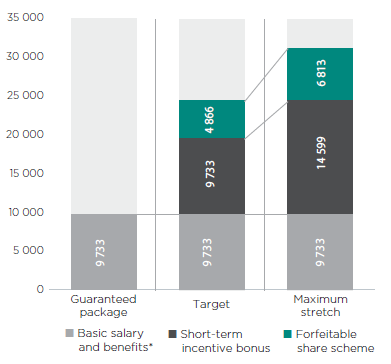
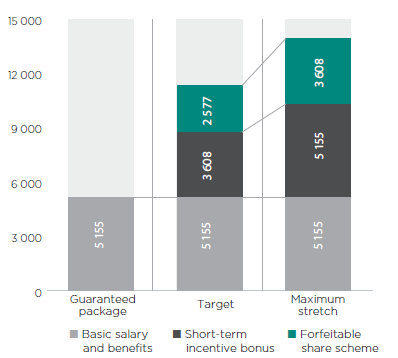
Executive Directors' composition of FY2020 total remuneration
Joint CEOs
(R’000) |
Financial Director
(R’000) |
 |
 |
| * |
In addition to the basic salary of R9.733 million each, the joint CEO's will receive R3.3 million each in line with the restraint of trade agreement that was concluded with them in November 2017. (As referred to on page 83 of the 2018 integrated annual report) |
| |
The tenure of the restraint of trade undertaking is 36 months, which commenced on 1 November 2017 and will expire on 31 October 2020. |
| |
The total restraint of trade amount payable over the 36 month period is R10.013 million per CEO. |
| |
In determining the short term incentives and forfeitable share scheme awards, the above restraint payments do not form part of the base calculation thereof. |
Long-term Incentive Plan
Blue Label's LTIP aligns employees to shareholder interests through incentivising performance in line with strategic goals and long-term shareholder value. In addition, they aim to retain human capital with scarce or critical skills. The Remco, through engagement with shareholders, has determined applicable criteria for LTIs, ensuring that the interests of all stakeholders are appropriately considered. These may be reviewed and adjusted in future, upon further engagement with shareholders. Awards are made once a year post our annual performance and pay reviews. All awards are subject to the necessary governance and approval processes. Awards are subject to vesting over a period of no less than three years from the date of the grant.
We have introduced some changes to our LTIP:
- Minimum levels of financial performance must be met. Employees who do not meet minimum performance requirements or are on a performance improvement plan, are not eligible.
- Awards from 2019 onwards are subject to malus and clawback provisions as set out in our policy (further detail can be accessed here.
- To further align management's interests directly with those of shareholders and to encourage long-term commitment to the organisation, Executive Directors will be expected to accumulate a minimum holding of shares from September 2019.
- Committees will take into consideration value contribution, experience, skill and transformation requirements.
From September 2019, the following metrics will apply for the performance period 1 June to 31 May of each year:
| |
|
Group LTI Financial Metrics* |
| |
|
Threshold |
Target |
Stretch |
| Core HEPS (30%) (compounded cumulatively over three years) |
Group |
CPI + 5% |
CPI + 10% |
CPI + 15% |
| Payout % |
1/3 of 30% |
3/3 of 30% |
38% of max |
| TSR (30%) |
Group |
Greater than or equal to JSECapped All Share Index |
JSE CappedAll Share IndexReturn + CPI + 5%(average not compounded overthree years) |
JSE CappedAll Share IndexReturn + CPI + 15% (average not compounded overthree years) |
| Payout % |
1/3 of 30% |
3/3 of 30% |
38% of max |
| ROCE** (20%) |
Group |
ROCE greater than or equal to WACC compounded over three years |
ROCE greater than or equal to WACC + 2.5% compounded over three years |
ROCE greater than or equal to WACC + 5% compounded over three years |
| Payout % |
1/3 of 20% |
3/3 of 20% |
24% of max |
| ESG*** (20%) |
Group |
Succession plansfor key roles |
B-BBEE performance + succession plans for key roles |
N/A |
| Payout % |
1/3 of 20% |
3/3 of 20% |
N/A |
| * |
Remco may review targets post-FY20. The LTI is calculated per objective. Values awarded will be a weighted average of scores attained versus target and pro-rated as the case may be. |
| ** |
ROCE is calculated using the following formula:
ROCE = Net operating profit (EBIT)/(total equity + net debt). Net debt = total liabilities minus cash. |
| *** |
ESG targets may be replaced for Executive Directors with personal strategic objectives. |
Malus and clawback provision
Our revised remuneration malus and clawback ensures that excessive risk-taking is not rewarded. This malus and clawback clause applies to both vested and unvested 'at risk' remuneration. It is designed to be preventative rather than a purely remedial or punitive measure as it removes the incentive for executives to consider deliberately misstating company earnings to inflate variable pay. The clause applies to both the STIP and LTIP from June 2019 and September 2019 respectively. May be implemented up to 10 years after a trigger event and is applicable to financial year ending 31 May 2020 and each financial year-end thereafter.
The Board may act on the recommendation of the Remuneration Committee to adjust (malus) or recover (clawback) unvested and vested 'at risk' remuneration where there is reasonable evidence that a Blue Label employee has materially contributed to, or been materially responsible for, the need for the restatement of financial results. The malus and clawback clause does not apply in the case of a restatement of financial results caused by a change in applicable accounting standards or interpretations thereof, provided originally approved by the company's auditors.
The CEOs or Company Secretary are required to notify the Chairman of the Remco and the Chairman of the Board respectively, of any circumstances that could constitute a 'trigger' under this policy as soon as practical. If either the CEOs or Company Secretary is involved in the trigger event, the Head of Group Risk and Compliance is required to notify the Chairman of the Remco and the Chairman of the Board respectively.
Before the Remco makes a recommendation to the Board to implement malus or clawback provisions under the policy, they shall:
- review the situation to understand the impact of the misstatement;
- assess the involvement of the employee and their level of responsibility regarding the trigger; and
- provide the relevant employee with written notice of the intended actions and the right to respond in writing within 15 working days to raise salient matters.
Having completed an investigation and following due process, the Board, on advice from the Remco, may decide to clawback, cancel or adjust any vested or unvested STI or LTI awards, where they are not satisfied that an award is appropriate or warranted due to exceptional circumstances.
Termination arrangements
Conditions of employment are comparable to those companies in our sector. In ordinary practice, no special or extraordinary conditions are applicable to senior executives. Exceptions may exist because of acquisitions and these must be reviewed and signed off by the Board and Remco.
In the event that services are terminated due to a no-fault basis, Executive Directors, prescribed officers and senior managers are entitled to severance pay equal to two weeks' FAR per completed year of service. Contractual notice and accrued leave will also be paid out in the normal course. Treatment of any unpaid bonus or unvested LTPI awards, will be dealt with in accordance with this policy and will in all instances be subject to Group Remco and Board oversight and approval.
In line with King IV, Blue Label has not concluded any termination agreements with its Executive Directors, other than a restraint of trade agreement entered into in 2017 with the joint CEOs. These are unlikely to be renewed after the three-year employment contract term. No fixed sums of money or "balloon payments" in recognition of service to the company, without any performance conditions attached, will be paid on termination of employment.
SECTION 3
Implementation report
Short-term incentive bonus
For the 2019 financial year, the Group did not achieve the levels required in terms of its predetermined targets for growth in core HEPS. As a result thereof, as well as the Executive Directors electing to forfeit bonuses for the non-financial targets, no short-term incentive bonuses were paid to them.
| Performance metric |
Target |
Actual
performance |
Weighting |
Amount paid
to Executive
Directors
R'000 |
Amount
forfeited
by
Executive
Directors
R'000 |
|
| Short-term incentive bonus |
|
|
|
|
| |
| Financial target |
|
|
|
|
| |
| Group core headline earnings per share growth |
greater/equal to CPI + 10% = 14.5% |
(325%) |
80% |
– |
– |
|
| Non-financial targets |
Varies across the Group |
Varies across the Group |
20% |
– |
5 088* |
|
| Total |
|
|
|
– |
5 088 |
|
| * |
The targets were met for the 20% non-financial measures. However, the Executive Directors elected to forfeit this portion of the short-term incentive bonus. |
Long-term Incentive Plan
The Long-term Incentive Plan related to the allocation of shares in 2015, which vested on 31 August 2018. The financial measurement was for the period 1 June 2015 to 31 May 2018.
The retention criteria of 40% was met.
Growth in core headline earnings per share over the three-year period equated to 41%. Growth in CPI over the three-year period accumulated to 16%, which after inclusion of the maximum growth target of 25%, equated to 41%. As the actual growth amounted to 41%, the resultant allocation of 50% was met.
In respect of growth in shareholder returns, the weighted average price per share at commencement of the allocation in September 2015 was R10.17. The required compounded growth of 10% per annum over the vesting period as at 31 August 2018 equated to a targeted share price of R13.54 inclusive of dividends paid totalling R0.76. The qualifying target equated to R12.78 net of dividends. The market price at vesting date was R7.16, therefore the minimum target requirement was not met. Therefore the 10% allocation relating to growth in shareholder returns did not vest.
On 31 August 2018, 90% of the 2015 share scheme allocations fell due.
Outperformance bonus
For the year ended 31 May 2019, the members of the Executive Committee did not qualify for an outperformance bonus due to the decline in the share price. The share price as at 31 May 2018 was R11.80. The target share price equated to R14.16, measured against the share price as at 31 May 2019 of R3.78. Therefore, the outperformance bonus was not achieved.
| Performance metric |
Target |
Actual
performance |
Weighting |
Amount paid
to Executive
Directors
R'000 |
|
| Long-term Incentive Plan (2015 forfeitable share scheme vested in August 2018) |
|
|
|
|
|
| Retention |
three years 25% + (cumulative CPI over three years) |
|
40% |
1 713 |
|
| Growth in core HEPS |
41% |
41% |
50% |
2 143 |
|
| Shareholder returns |
R12.78 market price per share |
R7.16 market price per share |
10% |
– |
|
| Total vesting related to performance conditions (excluding retention portion) included in 2019 total single figure of remuneration |
|
|
|
2 143 |
|
| Outperformance bonus |
|
|
|
|
|
| Annual growth in the share price |
R14.16 market price per share |
R3.78 market price per share |
– |
– |
|
Tables of single total figure of remuneration for FY2019
The single total figure of remuneration disclosure is based on the IoDSA and SARA application guidance issued in November 2017 on remuneration disclosure in accordance with King IV and presents the remuneration for executive management consisting of the Executive Directors of Blue Label Telecoms. The comparative information has been presented in a manner consistent with the current year presentation.
| Executive Directors' remuneration for the year ended 31 May 2019 |
Explanatory
notes |
|
| Fixed remuneration (including salary, allowances and retirement benefits) |
|
| 8 991 |
9 005 |
4 686 |
22 682 |
|
| Other benefits |
|
| 191 |
177 |
177 |
545 |
|
| Short-term incentive bonus |
1 |
|
– |
– |
– |
– |
|
| 2018 forfeitable share scheme – retention component on award date (1 September 2018) at fair value |
2 |
|
1 071 |
1 071 |
567 |
2 709 |
|
| 2015 forfeitable share scheme – growth performance component on vesting date (31 August 2018) at fair value |
3 |
|
847 |
847 |
449 |
2 143 |
|
| Outperformance bonus on award date at fair value |
1 |
|
– |
– |
– |
– |
|
| Single total figure of remuneration |
|
|
11 100 |
11 100 |
5 879 |
28 079 |
|
| 2018 forfeitable share scheme retention component |
5 |
|
(1 071) |
(1 071) |
(567) |
(2 709) |
|
| 2015 forfeitable share scheme – vesting of retention component in the current year at fair value |
6 |
|
677 |
677 |
359 |
1 713 |
|
| Dividends on vested shares |
7 |
|
210 |
210 |
111 |
532 |
|
| Short-term incentive bonus of prior year paid in August 2018 |
8 |
|
– |
– |
– |
– |
|
| Restraint of trade award monthly instalments paid during the year |
9 |
|
3 338 |
3 338 |
– |
6 676 |
|
| Total cash equivalent value remuneration received for the year ended 31 May 2019 |
10 |
|
14 254 |
14 254 |
5 782 |
34 291 |
|
| Reconciliation to note 5.3 of the Group annual financial statements |
|
|
|
|
|
|
|
| Remuneration as disclosed in terms of IFRS |
|
|
12 520 |
12 520 |
4 863 |
29 903 |
|
| Total cash equivalent value remuneration received for the year ended 31 May 2018 |
|
|
14 254 |
14 254 |
5 782 |
34 291 |
|
| Difference to remuneration as disclosed in note 5.3 |
|
|
1 734 |
1 734 |
919 |
4 388 |
|
| Reconciling items: |
|
|
|
|
|
|
|
| Short-term incentive bonus accrued in May 2018 and settled in August 2018 |
|
| – |
– |
– |
– |
|
| Dividends on shares vested in the current year |
|
| 210 |
210 |
111 |
532 |
|
| 2015 forfeitable share scheme that vested in the current year at fair value |
|
| 1 524 |
1 524 |
808 |
3 856 |
|
| 2015 forfeitable share scheme – growth performance component on vesting date (31 August 2018)
at fair value |
|
| 847 |
847 |
449 |
2 143 |
|
| 2015 forfeitable share scheme – vesting of retention component in the current year at fair value |
|
|
677 |
677 |
359 |
1 713 |
|
|
|
|
|
|
|
|
|
| |
|
|
1 734 |
1 734 |
919 |
4 388 |
|
| 1. |
No STI or outperformance bonuses, for the year ended 31 May 2019, were payable. |
| 2. |
The 33.33% LTI retention portion of the 2018 forfeitable share scheme, awarded on 1 September 2018, which will vest in three years from that date provided that the Executive Directors remain employed by Blue Label Telecoms. As there are no further performance conditions, this portion of the award is recognised at fair value in 'the Single Total Figure of Remuneration' in the year of award. |
| 3. |
The 60% LTI growth in core HEPS of the 2015 forfeitable share scheme that vested 1 September 2018. |
| 4. |
The restraint of trade payments of the joint CEOs, although payable in 36 equal instalments, were included in the 2018 Single Total Figure of Remuneration in that there were no conditions pertaining thereto other than retention of employment. This took effect from the 1 November 2017. |
| 5. |
The 33.33% LTI retention portion of the 2018 forfeitable share scheme is deducted from 'the Total Cash Equivalent Value Remuneration received', as vesting will only take place on 31 August 2021. |
| 6. |
The 40% LTI retention portion of the 2015 forfeitable share scheme is added to 'the Total Cash Equivalent Value Remuneration received', as vesting took place on 31 August 2018. |
| 7. |
Dividends are the total of cash receipts during the financial year applicable to the 2015 forfeitable share scheme, as vesting took place on 31 August 2018. |
| 8. |
These amounts relate to the STI bonuses paid in August 2018, which were derived from performance for the year ended 31 May 2018. |
| 9. |
These amounts represent the 12 monthly instalments received during the year. |
| 10. |
Cash equivalent value remuneration represents the total proceeds paid to the Executive Directors for the period 1 June 2018 to the 31 May 2019, inclusive of the cash element of basic remuneration, STIs, LTIs and dividends. |
Executive Directors' remuneration for the year ended 31 May 2018:
| Executive Directors' remuneration for the year ended 31 May 2018 |
Explanatory
notes |
BM Levy
R'000 |
MS Levy
R'000 |
DA Suntup
R'000 |
Total
R'000 |
|
| Fixed remuneration (including salary, allowances and retirement benefits) |
|
8 486 |
8 499 |
4 425 |
21 410 |
|
| Other benefits |
|
176 |
163 |
163 |
502 |
|
| Short-term incentive bonus |
1 |
– |
– |
– |
– |
|
| 2017 forfeitable share scheme – retention component on award date (1 September 2017) at fair value |
2 |
1 011 |
1 011 |
535 |
2 557 |
|
| 2014 forfeitable share scheme – growth performance component on vesting date (31 August 2017) at fair value |
3 |
3 143 |
3 143 |
1 665 |
7 951 |
|
| Outperformance bonus on award date at fair value |
1 |
– |
– |
– |
– |
|
| Three-year restraint of trade award settled in equal monthly instalments over 36 months with effect from 1 November 2017 |
4 |
10 013 |
10 013 |
– |
20 026 |
|
| Single total figure of remuneration |
|
22 829 |
22 829 |
6 788 |
52 446 |
|
| 2017 forfeitable share scheme retention component |
5 |
(1 011) |
(1 011) |
(535) |
(2 557) |
|
| 2014 forfeitable share scheme - vesting of retention component in the current year at fair value |
6 |
2 096 |
2 096 |
1 110 |
5 302 |
|
| Dividends on vested shares |
7 |
317 |
317 |
168 |
802 |
|
| Short-term incentive bonus of prior year paid in August 2017 |
8 |
7 808 |
7 808 |
2 412 |
18 028 |
|
| Restraint of trade award still to be settled in 29 equal monthly instalments |
9 |
(8 066) |
(8 066) |
– |
(16 132) |
|
| Total cash equivalent value remuneration received for the year ended 31 May 2018 |
10 |
23 973 |
23 973 |
9 943 |
57 889 |
|
| Reconciliation to note 5.3 of the Group annual financial statements |
|
|
|
|
|
|
| Remuneration as disclosed in terms of IFRS |
|
10 609 |
10 609 |
4 588 |
25 806 |
|
| Total cash equivalent value remuneration received for the year ended 31 May 2018 |
|
23 973 |
23 973 |
9 943 |
57 889 |
|
| Difference to remuneration as disclosed in note 5.3 |
|
13 364 |
13 364 |
5 355 |
32 083 |
|
| Reconciling items: |
|
|
|
|
|
|
| Short-term incentive bonus accrued in May 2017 and settled in August 2017 |
|
7 808 |
7 808 |
2 412 |
18 028 |
|
| Dividends on shares vested in the current year |
|
317 |
317 |
168 |
802 |
|
| 2014 forfeitable share scheme that vested in the current year at fair value |
|
5 239 |
5 239 |
2 775 |
13 253 |
|
| 2014 forfeitable share scheme – growth performance component on vesting date (31 August 2017) at fair value |
|
3 143 |
3 143 |
1 665 |
7 951 |
|
| 2014 forfeitable share scheme – vesting of retention component in the current year at fair value |
|
2 096 |
2 096 |
1 110 |
5 302 |
|
|
|
|
|
|
|
|
| |
|
13 364 |
13 364 |
5 355 |
32 083 |
|
| 1. |
No STI or outperformance bonuses, for the year ended 31 May 2018, were payable. |
| 2. |
The 33.33% LTI retention portion of the 2017 forfeitable share scheme, awarded on 1 September 2017, which will vest in three years from that date provided that the Executive Directors remain employed by Blue Label Telecoms. As there are no further performance conditions, this portion of the award is recognised at fair value in "the single total figure of remuneration" in the year of award. |
| 3. |
The 66.67% LTI growth in core HEPS and shareholder return of the 2014 forfeitable share scheme that vested 1 September 2017. |
| 4. |
The restraint of trade payments of the joint CEOs, although payable in 36 equal instalments, have been included in total in "the single total figure of remuneration" in that there are no conditions pertaining thereto other than retention of employment. This took effect from 1 November 2017. |
| 5. |
The 33.33% LTI retention portion of the 2017 forfeitable share scheme is deducted from 'the single total figure of remuneration', as vesting will only take place on 31 August 2020. |
| 6. |
The 33.33% LTI retention portion of the 2014 forfeitable share scheme is added to 'the single total figure of remuneration', as vesting took place on 31 August 2017. |
| 7. |
Dividends are the total of cash receipts during the financial year applicable to the 2014 forfeitable share scheme, as vesting took place on 31 August 2017. |
| 8. |
These amounts relate to the STI bonuses paid in August 2017, which were derived from performance for the year ended 31 May 2017. |
| 9. |
These amounts represent 29 equal monthly instalments, being the balance payable, post 31 May 2018, on the restraint of trade agreements. |
| 10. |
Cash equivalent value remuneration represents the total proceeds paid to the Executive Directors for the period 1 June 2017 to the 31 May 2018, inclusive of the cash element of basic remuneration, STIs, LTIs and dividends. |
Compliance with policy
The Remuneration and Nomination Committee is satisfied that the Remuneration and Reward Policy has been complied with for the year under review in so far as Executive Management is concerned.
Forfeitable share scheme – granted and unvested
| |
| Forfeitable share scheme per Director |
|
|
|
|
|
|
|
|
|
|
|
| For the year ended 31 May 2019 |
|
|
|
|
|
|
|
|
|
| |
| BM Levy |
1 September 2015 |
10.17 |
31 August 2018 |
262 834 |
– |
(26 283) |
(236 551) |
– |
2 673 |
– |
|
| BM Levy |
18 October 2016 |
20.75 |
31 August 2019 |
137 194 |
– |
– |
– |
137 194 |
2 847 |
519 |
|
| BM Levy |
1 September 2017 |
18.49 |
31 August 2020 |
163 970 |
– |
– |
– |
163 970 |
3 032 |
620 |
|
| BM Levy |
3 September 2018 |
7.16 |
31 August 2021 |
– |
448 843 |
– |
– |
448 843 |
3 214 |
1 697 |
|
|
|
|
|
563 998 |
448 843 |
(26 283) |
(236 551) |
750 007 |
11 765 |
2 835 |
|
| MS Levy |
1 September 2015 |
10.17 |
31 August 2018 |
262 834 |
– |
(26 283) |
(236 551) |
– |
2 673 |
– |
|
| MS Levy |
18 October 2016 |
20.75 |
31 August 2019 |
137 194 |
– |
– |
– |
137 194 |
2 847 |
519 |
|
| MS Levy |
1 September 2017 |
18.49 |
31 August 2020 |
163 970 |
– |
– |
– |
163 970 |
3 032 |
620 |
|
| MS Levy |
3 September 2018 |
7.16 |
31 August 2021 |
– |
448 843 |
– |
– |
448 843 |
3 214 |
1 697 |
|
|
|
|
| 683 367 |
448 843 |
– |
(283 339) |
750 007 |
11 765 |
2 835 |
|
| DA Suntup |
1 September 2015 |
10.17 |
31 August 2018 |
139 207 |
– |
(13 921) |
(125 286) |
– |
1 415 |
– |
|
| DA Suntup |
18 October 2016 |
20.75 |
31 August 2019 |
72 663 |
– |
– |
– |
72 663 |
1 508 |
275 |
|
| DA Suntup |
1 September 2017 |
18.49 |
31 August 2020 |
86 845 |
– |
– |
– |
86 845 |
1 606 |
328 |
|
| DA Suntup |
3 September 2018 |
7.16 |
31 August 2021 |
– |
237 725 |
– |
– |
237 725 |
1 702 |
899 |
|
|
|
|
|
361 937 |
86 845 |
– |
(150 067) |
397 233 |
6 231 |
1 502 |
|
| # |
Awards include both the retention and performance instruments not yet vested. |
| * |
The fair value is based on the closing price of R3.78 at 31 May 2019 and excludes performance criteria. |
Non-Executive remuneration
| |
| Non-Executive Directors |
|
|
| LM Nestadt |
1 950 |
|
| K Ellerine |
604 |
|
| G Harlow |
1 638 |
|
| J Mthimunye |
1 065 |
|
| JS Vilakazi |
747 |
|
| P Mahanyele** |
374 |
|
| |
6 378 |
|
| ** |
P Mahanyele resigned with effect from 23 November 2018. |
The proposed fees payable to Non-Executive Directors are set out below:
|
Current
fee
2019
R |
Proposed
fee
2020
R |
|
| Services as Directors |
|
|
|
| – Chairman of the Board (per annum) |
1 802 000 |
1 910 120 |
|
| – Board members (per annum) |
397 500 |
421 350 |
|
| Audit, Risk and Compliance Committee |
|
|
|
| – Chairman (per annum) |
360 400 |
382 024 |
|
| – Member (per annum) |
222 600 |
235 956 |
|
| Remuneration and Nomination Committee |
|
|
|
| – Chairman remuneration (per annum) |
212 000 |
224 720 |
|
| – Chairman nomination (per annum) |
148 400 |
157 304 |
|
| – Member (per annum) |
127 200 |
134 832 |
|
| Investment Committee |
|
|
|
| – Chairman (per annum) |
212 000 |
224 720 |
|
| – Member (per annum) |
127 200 |
134 832 |
|
| Transformation, Social and Ethics Committee |
|
|
|
| – Chairman (per annum) |
127 200 |
134 832 |
|
| – Member (per annum) |
79 500 |
84 270 |
|
| Ad hoc Committee |
|
|
|
| – Chairman (per meeting) |
47 700 |
50 562 |
|
| – Member (per meeting) |
28 620 |
30 337 |
|
GD Harlow
Remuneration Committee Chairman
29 October 2019